
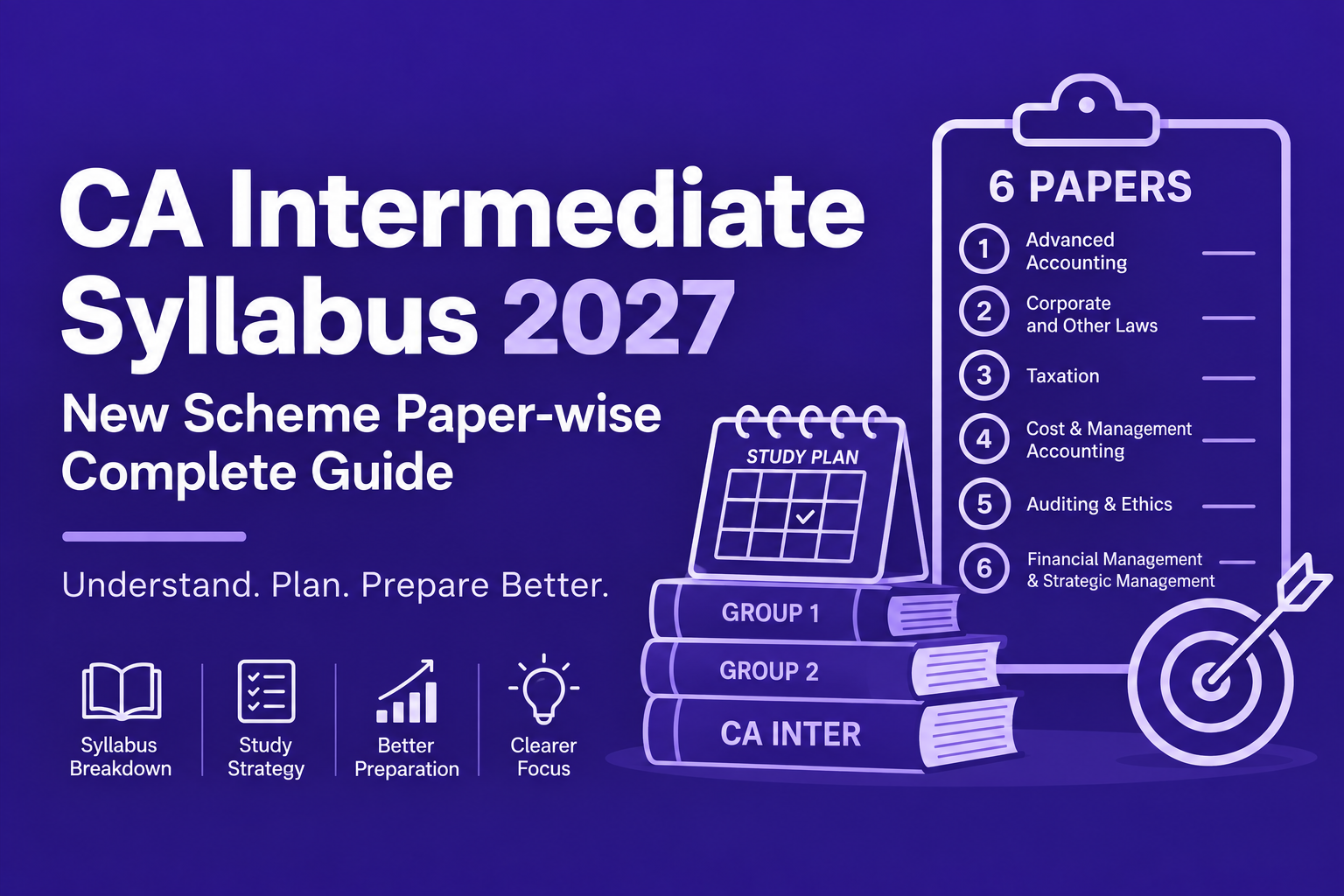
A complete breakdown of the CA Intermediate syllabus 2027 under the New Scheme — all six papers across both groups, what each paper demands, study methods, and a step-by-step framework to turn the syllabus into a workable study plan.
The CA Intermediate syllabus 2027 new scheme has six papers divided into two groups. Group 1 covers Advanced Accounting, Corporate and Other Laws, and Taxation. Group 2 covers Cost and Management Accounting, Auditing and Ethics, and Financial Management and Strategic Management. (ICAI)
If you are preparing for the May 2027, September 2027, or January 2028 exams, do not plan your studies using an old syllabus or old paper structure.
ICAI has already released 2027-applicable study material for several papers. It has also announced the applicability of the Income-tax Act, 2025 from the May 2027 CA exams onward, so Taxation needs special attention. (ICAI)
This guide explains the six papers, how the groups are structured, what each paper requires, and how to turn the syllabus into a workable study plan.
What Is the CA Intermediate Syllabus 2027?
The CA Intermediate syllabus 2027 follows ICAI's New Scheme of Education and Training and contains six papers across two groups. Group 1 includes Advanced Accounting, Corporate and Other Laws, and Taxation. Group 2 includes Cost and Management Accounting, Auditing and Ethics, and Financial Management and Strategic Management. (ICAI)
The six papers are:
Group 1
- Paper 1 — Advanced Accounting
- Paper 2 — Corporate and Other Laws
- Paper 3 — Taxation (Section A: Income-tax Law, Section B: Goods and Services Tax)
Group 2
- Paper 4 — Cost and Management Accounting
- Paper 5 — Auditing and Ethics
- Paper 6 — Financial Management and Strategic Management
This structure is the starting point for your preparation. (ICAI)
CA Intermediate Syllabus 2027 New Scheme: Paper-wise Overview
| Paper | Subject | Group | Main Preparation Style |
|---|---|---|---|
| Paper 1 | Advanced Accounting | Group 1 | Concepts + problem solving |
| Paper 2 | Corporate and Other Laws | Group 1 | Reading + recall + application |
| Paper 3 | Taxation | Group 1 | Concepts + provisions + practical questions |
| Paper 4 | Cost and Management Accounting | Group 2 | Concepts + numerical practice |
| Paper 5 | Auditing and Ethics | Group 2 | Understanding + recall + answer writing |
| Paper 6 | Financial Management & Strategic Management | Group 2 | Numerical practice + theory recall |
The six papers are not equally demanding in the same way.
That matters when you build your timetable.
A student who gives every subject exactly two hours every day may have a balanced calendar but a poor study plan.
Group 1 — CA Intermediate 2027
Paper 1: Advanced Accounting
Advanced Accounting is the first paper in Group 1. It requires a combination of conceptual understanding and repeated problem-solving. You should not treat it like a reading subject.
What to Focus On
Your preparation should generally include areas such as:
- Accounting standards and related principles
- Financial statements
- Partnership-related accounting
- Company accounts
- Special accounting situations
- Other applicable accounting topics in the ICAI study material
Always use the study material applicable to your exam attempt rather than relying on an older chapter list. ICAI has specifically published Advanced Accounting study material marked applicable for May 2027 examinations onwards. (ICAI)
How to Study Advanced Accounting
Use this sequence:
Concept → Solved Example → Independent Question → Mistake Review → Reattempt
Do not stop after watching a lecture. You understand a question while the teacher is solving it. Then you try the next question alone and suddenly cannot decide which treatment to use. That is normal. It is also exactly why independent practice is necessary.
Track These Things
For each chapter, track:
- Concept completed
- Questions solved
- Wrong questions
- Reattempted questions
- Revision completed
- Timed practice
Paper 2: Corporate and Other Laws
Corporate and Other Laws is different from Advanced Accounting. Here, understanding the rule is only the first step. You also need to remember the conditions and apply the rule to a situation. ICAI's 2027-applicable material includes Corporate and Other Laws under Paper 2 of Group 1. (ICAI)
How to Approach Law
After studying a topic, close the book. Ask yourself:
- What is the main rule?
- What conditions apply?
- Are there exceptions?
- What is the practical meaning?
- Can I explain it without looking?
Then attempt a question. You read a section three times and it starts feeling familiar. Later, you try to write the answer and the exact conditions do not come to mind. That is the difference between recognition and recall.
Better Law Revision
Use:
- Short recall sessions
- Written practice
- Case-based questions
- Keyword revision
- Repeated revision
Do not depend entirely on repeated reading.
Paper 3: Taxation
Taxation deserves special attention for 2027 aspirants because the applicable tax law changes. ICAI has stated that the Income-tax Act, 2025 will apply from the May 2027 CA examinations onward. (ICAI)
So students preparing for 2027 should not blindly use tax material prepared for an earlier attempt.
Section A: Income-tax Law
The 2027-applicable study material includes areas such as:
- Basic concepts
- Residential status and scope of total income
- Heads of income — Salaries, Income from house property, Profits and gains of business or profession, Capital gains, Income from other sources
ICAI's published 2027 material specifically lists these areas in its Income-tax Law section. (ICAI)
Section B: GST
The 2027-applicable GST material includes topics such as:
- GST in India, Supply and Charge of GST
- Place of supply, Exemptions, Time of supply, Value of supply
- Input Tax Credit, Registration, Tax invoice
- Accounts and records, E-Way Bill, Payment of tax
- TDS and TCS, Returns
These topics are included in ICAI's material applicable for the May 2027, September 2027, and January 2028 exams. (ICAI)
Tax Preparation Requires Current Material
Tax is not a subject where an old book is "almost good enough." The applicable law matters. Before starting serious preparation, check the ICAI material and applicability for your exact attempt.
Group 2 — CA Intermediate 2027
Paper 4: Cost and Management Accounting
Cost and Management Accounting is Paper 4 of Group 2. It is a practice-heavy paper. ICAI's study material applicable from May 2027 includes topics such as material cost, employee cost, overheads, activity-based costing, cost sheets, costing systems, unit and batch costing, job costing, process costing, joint products, service costing, standard costing, marginal costing, and budgets. (ICAI)
How to Study Costing
Do not solve questions only when you feel confident. Use practice to build confidence. A useful session might look like:
- Review the concept.
- Follow one solved example.
- Solve five similar questions.
- Mark errors.
- Reattempt the difficult ones later.
You solve ten questions correctly. Then one unusual question appears and you immediately check the solution. Do not skip it. That question may be showing you exactly where your understanding is incomplete.
Paper 5: Auditing and Ethics
Auditing and Ethics requires a different study approach. There is substantial theory, but simply reading the material repeatedly is not enough. You need to understand what the concept means, why the auditor performs a procedure, what the relevant requirement is, how to structure an answer, and which keywords matter.
ICAI lists Auditing and Ethics as Paper 5 of Group 2 under the New Scheme and has 2027-applicable study material available. (ICAI)
How to Study Audit
After completing a topic:
Read → Close the book → Recall → Write → Compare
This is especially useful for theory-heavy chapters. The timer ends, but you realise most of the session was spent highlighting sentences. Highlighting can help. But it should not become the main form of revision.
Paper 6: Financial Management and Strategic Management
Paper 6 contains two distinct sections:
Section A: Financial Management
This is the numerical side of the paper. You need:
- Conceptual understanding
- Formula recall
- Question practice
- Calculation speed
- Accuracy
Section B: Strategic Management
This is more theory-oriented. It needs:
- Concept understanding
- Recall
- Structured revision
- Application to questions
ICAI's New Scheme lists Paper 6 as Financial Management and Strategic Management, with the two sections forming the paper. (ICAI)
Do Not Study Both Sections in the Same Way
FM needs repeated problem-solving. SM needs repeated recall. A useful day could therefore be:
- FM: Solve 20 questions
- SM: Revise one chapter + attempt recall questions
This is more effective than reading both sections for equal amounts of time.
How the Six Papers Differ
| Paper | Nature | What Builds Skill | What Students Often Get Wrong |
|---|---|---|---|
| Advanced Accounting | Practical | Repeated solving | Watching solutions instead of solving |
| Corporate & Other Laws | Theory + application | Recall + answer writing | Passive reading |
| Taxation | Practical + theory | Concepts + current provisions + questions | Using outdated material |
| Cost & Management Accounting | Practical | Regular numerical practice | Irregular practice |
| Auditing & Ethics | Theory | Recall + answer writing | Excessive highlighting |
| FM & SM | Mixed | Numericals + structured recall | Treating FM and SM identically |
The right study method changes from paper to paper.
Why Students Struggle With the New Scheme
The six-paper structure looks manageable when listed on a page. It feels different when all six are unfinished. You open your planner. Advanced Accounting is at 40%. Law is at 25%. Tax has barely started. Then you remember Costing and Audit.
The result is often a very detailed timetable that becomes impossible to follow after a few days.
Another common pattern is spending too much time on the current chapter. You spend four hours making sure one chapter is "perfect." Meanwhile, three other subjects have received no attention.
The problem is not always effort. It is allocation. A good CA Intermediate plan manages unfinished work, not just study hours.
What Actually Works for CA Intermediate 2027
A practical system has five stages:
- 1. Learn — Understand the chapter.
- 2. Practise — Solve questions while the concept is still fresh.
- 3. Recall — Return later without immediately opening the book.
- 4. Test — Attempt questions under time limits.
- 5. Correct — Study the mistakes and reattempt them.
This creates a feedback loop. Without the last two stages, you may know the syllabus but still struggle to perform under exam conditions.
Step-by-Step CA Intermediate 2027 Study Framework
Step 1: Start With the Official Material
Use the ICAI study material applicable to your exam attempt. This is especially important for Taxation because of the law changes applicable from May 2027. (ICAI) Do not build your preparation around random old PDFs.
Step 2: Break Every Paper Into Chapters
Your planner should not simply say: Taxation — 20%. Instead:
- Chapter 1 — Completed
- Chapter 2 — Learning
- Chapter 3 — Not Started
- Chapter 4 — Revised
- Chapter 5 — Needs Practice
This gives you something actionable.
Step 3: Give Every Chapter a Status
Use a simple system:
Not Started → Learning → Completed → Revised → Practised → Tested
A chapter should not be marked "done" just because you watched the lecture.
Step 4: Create Weekly Group Targets
For example:
- Group 1 — Advanced Accounting: 2 chapters, Law: 2 chapters, Tax: 2 chapters, plus revision of previous weak topics
- Group 2 — Costing: 2 chapters, Audit: 2 chapters, FM/SM: 2 chapters, plus revision of previous weak topics
Adjust these targets according to chapter size. A large chapter may need an entire week.
Step 5: Do Not Abandon One Group Completely
If you are preparing both groups, long gaps create a memory problem. You do not necessarily need to study both groups every day. But maintain regular contact. For example:
- Monday: Group 1
- Tuesday: Group 2
- Wednesday: Group 1
- Thursday: Group 2
- Friday: Mixed revision
- Saturday: Practice
- Sunday: Test + review
A Practical Daily Study Structure
A full-time student might use an eight-hour day like this:
| Block | Duration | Work |
|---|---|---|
| Block 1 | 2 hours | Difficult subject |
| Block 2 | 2 hours | Second subject |
| Block 3 | 1.5 hours | Revision |
| Block 4 | 1.5 hours | Question practice |
| Block 5 | 1 hour | Recall + mistakes |
You can change the duration. The important thing is not spending all eight hours on new material. Revision and practice need space from the beginning.
Why This Actually Works
Attention Span
A chapter becomes easier to start when the task is specific. "Study Tax" feels large. "Complete Residential Status and solve 15 questions" is concrete.
Mental Fatigue
Advanced Accounting, Costing, Tax, and FM can require sustained problem-solving. Your performance will naturally fall after long periods of difficult work. Use lower-energy periods for recall or lighter theory.
Energy Cycles
Put your hardest paper in your strongest study window. For some students, that is morning. For others, it is evening. There is no reason to copy another student's clock.
Cognitive Load
Six unfinished subjects create a lot of mental clutter. A chapter-level tracker reduces that load because you can see exactly what remains.
The purpose of a study plan is not to control every minute. It is to remove uncertainty about what comes next.
Common CA Intermediate Syllabus 2027 Mistakes
1. Using Old Tax Material
This is particularly risky for the 2027 attempt because of the tax-law applicability changes. Always check the material applicable to your exam. (ICAI)
2. Treating All Six Papers Equally
Some papers require more practice. Some require more recall. Your time allocation should reflect that.
3. Completing Lectures and Calling It Preparation
Lecture completion is only one stage. You still need independent questions.
4. Ignoring Revision
You finish Chapter 1 and move to Chapter 10. Then Chapter 1 feels unfamiliar. Keep older chapters in rotation.
5. Waiting Too Long to Test
Tests should not be saved for the final days. Start with chapter and topic tests. Move to full-paper tests later.
6. Making the Timetable Too Detailed
You plan every hour for the next six months. Then one bad week makes the entire timetable useless. Plan in weekly blocks.
When Should You Adjust Your Study Plan?
Adjust your plan when a problem repeats. For example:
- Advanced Accounting remains behind for three weeks.
- Law revision keeps getting cancelled.
- Tax questions show the same conceptual mistakes.
- Costing practice is irregular.
- Audit recall remains weak.
- FM accuracy is low.
- SM is repeatedly postponed.
Do not redesign everything because of one bad day. Look for patterns. If a target repeatedly fails, either the target is too large or the system around it is not working.
Three Things to Remember
- A completed chapter is not necessarily a prepared chapter.
- Taxation needs current, attempt-specific material.
- Your weekly balance matters more than a perfect daily timetable.
How to Turn the 2027 Syllabus Into a Study Plan
Once you have the official paper structure, the next step is to convert it into weekly work. A practical CA Intermediate study plan for 2027 should include:
- Chapter targets
- Daily study tasks
- Revision dates
- Question practice
- Mock tests
- Mistake tracking
- Group-wise progress
A simple syllabus tracker can make this easier. You do not need to track every minute. Track what matters: What is completed, what needs revision, and what still cannot be solved independently?
That information is enough to make your next study decision.
For related preparation, a CA Intermediate study timetable can help you convert the syllabus into a weekly schedule, while a CA Intermediate revision strategy becomes useful once your first syllabus coverage is complete.
Frequently Asked Questions
What is the CA Intermediate syllabus for 2027?
The CA Intermediate 2027 syllabus under the New Scheme has six papers across two groups. Group 1 includes Advanced Accounting, Corporate and Other Laws, and Taxation. Group 2 includes Cost and Management Accounting, Auditing and Ethics, and Financial Management and Strategic Management. (ICAI)
Is the CA Intermediate syllabus changing for 2027?
The New Scheme structure remains six papers across two groups, but students preparing for 2027 must use the study material applicable to their examination attempt. Taxation needs particular attention because ICAI has announced the applicability of the Income-tax Act, 2025 from the May 2027 CA examinations onward. (ICAI)
What are the six subjects in CA Intermediate 2027?
The six papers are Advanced Accounting, Corporate and Other Laws, Taxation, Cost and Management Accounting, Auditing and Ethics, and Financial Management and Strategic Management. (ICAI)
Which CA Intermediate papers are in Group 1?
Group 1 contains three papers: Advanced Accounting, Corporate and Other Laws, and Taxation. Taxation has two sections: Income-tax Law and Goods and Services Tax. (ICAI)
Which CA Intermediate papers are in Group 2?
Group 2 contains: Cost and Management Accounting, Auditing and Ethics, and Financial Management and Strategic Management. (ICAI)
Is the Income-tax Act, 2025 applicable for CA Intermediate 2027?
Yes. ICAI has announced that the Income-tax Act, 2025 is applicable from the May 2027 CA examinations onward. Students preparing for May 2027 and later attempts should therefore use the applicable ICAI Taxation study material rather than relying on material prepared for earlier attempts. (ICAI)
Where should I get the CA Intermediate 2027 study material?
Use the latest ICAI study material for the specific paper and examination attempt. ICAI's official resources identify 2027-applicable material for Advanced Accounting, Corporate and Other Laws, Taxation, Cost and Management Accounting, Auditing and Ethics, and Financial Management and Strategic Management. (ICAI)
How should I start preparing for CA Intermediate 2027?
Start by confirming the official material applicable to your attempt. Then break each of the six papers into chapter-level targets. Study new topics, practise questions immediately, keep older topics in revision, and introduce tests before the final revision period.