
On this page
- What is a CA Intermediate study planner?
- Why Intermediate is hard to plan
- Why most timetables fail
- How to create your study plan
- Subject-wise planning
- Group 1 study plan
- Group 2 study plan
- Both groups study plan
- Daily study plans (4–10 hours)
- Weekly plan
- Monthly plan
- Revision planner
- Mock tests & analysis
- Syllabus tracking
- How MyCAPlanner helps
- The weekly workflow
- Notebook vs Excel vs app
- Staying consistent
- When you fall behind
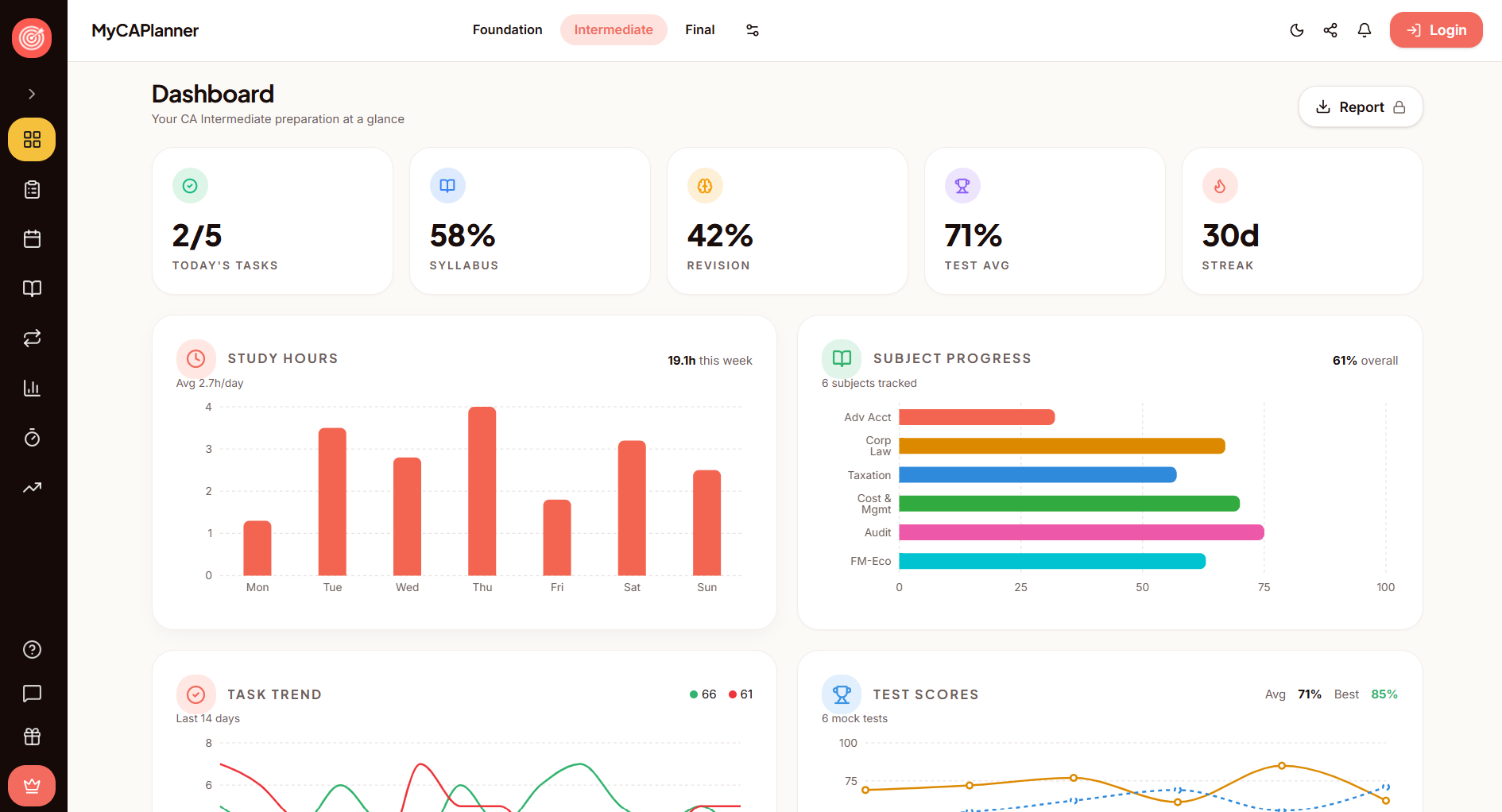
- Example study dashboard
- 15 common mistakes
- Planning checklist
- 20+ questions answered
What is a CA Intermediate study planner?
A CA Intermediate study planner is a system that converts the ICAI syllabus into dated, chapter-level work and then keeps a record of what happened to each chapter — studied, revised, practised, tested. That last part is what separates a planner from a timetable.
The confusion is worth clearing up, because most students build the wrong thing and then blame themselves when it stops working.
| Tool | What it answers | Where it stops |
|---|---|---|
| Timetable | What am I studying at 7 p.m. today? | Says nothing about total coverage or revision |
| To-do list | What tasks are pending right now? | Forgets a task the moment it is ticked |
| Study planner | What should I study this week, and why that? | Needs tracking to stay honest |
| Progress tracker | How much of the syllabus is actually done? | Doesn't tell you what to do today |
| Revision planner | Which chapters are due for their next pass? | Only useful if learning is tracked first |
Each of these solves one part of the problem. CA Intermediate needs all five working together, because the exam does not test what you studied — it tests what you can still reproduce, under time pressure, eight months after you first read it.
Insight: the "I studied it once" trap
Marking a chapter complete records an event, not a capability. Amalgamation read once in July and never revisited is not a completed chapter in November — it is an untested one. A planner that only counts completion will quietly overstate your readiness for months.
Why CA Intermediate preparation is difficult to plan
Intermediate is the first level where planning failure is expensive. Foundation is four papers with a shorter runway. Intermediate is six papers under the current ICAI scheme — Advanced Accounting, Corporate and Other Laws and Taxation in Group 1; Cost and Management Accounting, Auditing and Ethics and Financial Management and Strategic Management in Group 2 — each with its own preparation style.
- The syllabus is large enough that you cannot hold it in your head. By week three you genuinely will not remember which Taxation chapters you covered.
- Subject types differ. Accounts and Costing need daily practice. Law and Audit need repeated recall. FM needs formula fluency; SM needs structured writing.
- Theory decays fast. A Law chapter read once in month one is close to gone by month four without a revision pass.
- Question practice competes with new learning for the same hours, and new learning usually wins — which is exactly the wrong outcome.
- Mock tests need three uninterrupted hours plus review time, which a tight daily plan rarely has room for.
- Life is not stable. Articleship, college, family events and illness will take days from you. A plan that assumes they won't is fiction.
- Preparation cycles are long. Motivation cannot carry six months; only structure can.
- Repeat attempts need a different plan from first attempts, since coverage already exists but reliability does not.
This is why a rigid hour-by-hour timetable usually fails within two weeks. It assumes every day is identical and every chapter takes the time you guessed. Neither is true. A plan built on weekly targets with daily flexibility bends instead of breaking.
Why most CA Intermediate study timetables fail
Ten failure patterns, and what to do instead.
| Problem | Why it hurts | Do this instead |
|---|---|---|
| Overplanning | Every hour is allocated, so one disruption breaks the entire week | Plan roughly 70% of available hours and leave the rest unassigned |
| Unrealistic study hours | A 12-hour plan produces 5 real hours and a sense of failure | Start with hours you have already achieved for a full week, then add |
| No buffer days | Missed work has nowhere to go and rolls forward forever | Keep one catch-up slot per week and one catch-up week per two months |
| No revision slots | Revision becomes a final-month emergency across six papers | Book revision into the weekly plan from week one |
| Ignoring weak subjects | Students revise what feels comfortable, not what is failing | Schedule weak chapters in your best hours, not your leftover hours |
| Planning only new topics | Coverage grows while retention falls | Every study day should contain some old material |
| Not tracking completion | You cannot tell coverage from memory after a month | Track at topic level with a studied / revised / tested status |
| Taking tests without analysis | Scores repeat because mistakes are never converted into work | Every test produces at least three dated study tasks |
| No recovery plan | One bad week triggers a full plan rewrite | Define in advance what gets dropped when you lose three days |
| Treating every chapter equally | Low-weight chapters consume time meant for scoring ones | Rank chapters by weight and difficulty before allocating sessions |
| Constant timetable editing | Planning replaces studying and feels productive | Edit the plan once a week, at a fixed review time |
Mistake: the planning illusion
A colour-coded timetable produces the same feeling of accomplishment as an hour of study, with none of the benefit. If you have rebuilt your plan more than twice this month, the plan is not the problem.
Set up your syllabus once; the tracker keeps score after that.
How to create a CA Intermediate study plan, step by step
Step 1 — Understand the syllabus you are actually facing
Open the current ICAI study material and list the chapters of each paper you are attempting. Do not work from a coaching schedule or an old PDF; the Intermediate scheme has changed, and planning against a superseded structure wastes weeks. You want a written chapter list per paper before anything else.
Step 2 — Decide Group 1, Group 2 or both
This decision drives everything. Be honest about the hours available between today and the exam. As a rough guide, one group needs a sustained 4 to 5 focused hours a day over four to five months; both groups need 7 to 9. If your available hours sit between the two, one group with strong preparation usually beats two groups with thin preparation.
Step 3 — Break subjects into units you can finish in one sitting
"Study Costing" is not a task. "Process Costing — normal and abnormal loss, 12 sums" is. Aim for units of 60 to 120 minutes. Small units are the single biggest reason plans get completed, because they are finishable on a bad day.
Step 4 — Estimate time honestly
Give each chapter a session estimate, then add 30%. Every experienced student underestimates practical chapters. Track your first two weeks against the estimate and recalibrate — after that, your numbers become useful rather than optimistic.
Step 5 — Set weekly goals
Weekly goals are the right unit for CA preparation. They are long enough to absorb one bad day and short enough to correct course. A good week states chapters, not hours: "Advanced Accounting — Branch Accounts complete + 20 sums; Taxation — Capital Gains complete; Law — one revision pass on Incorporation."
Step 6 — Convert weekly goals into daily tasks
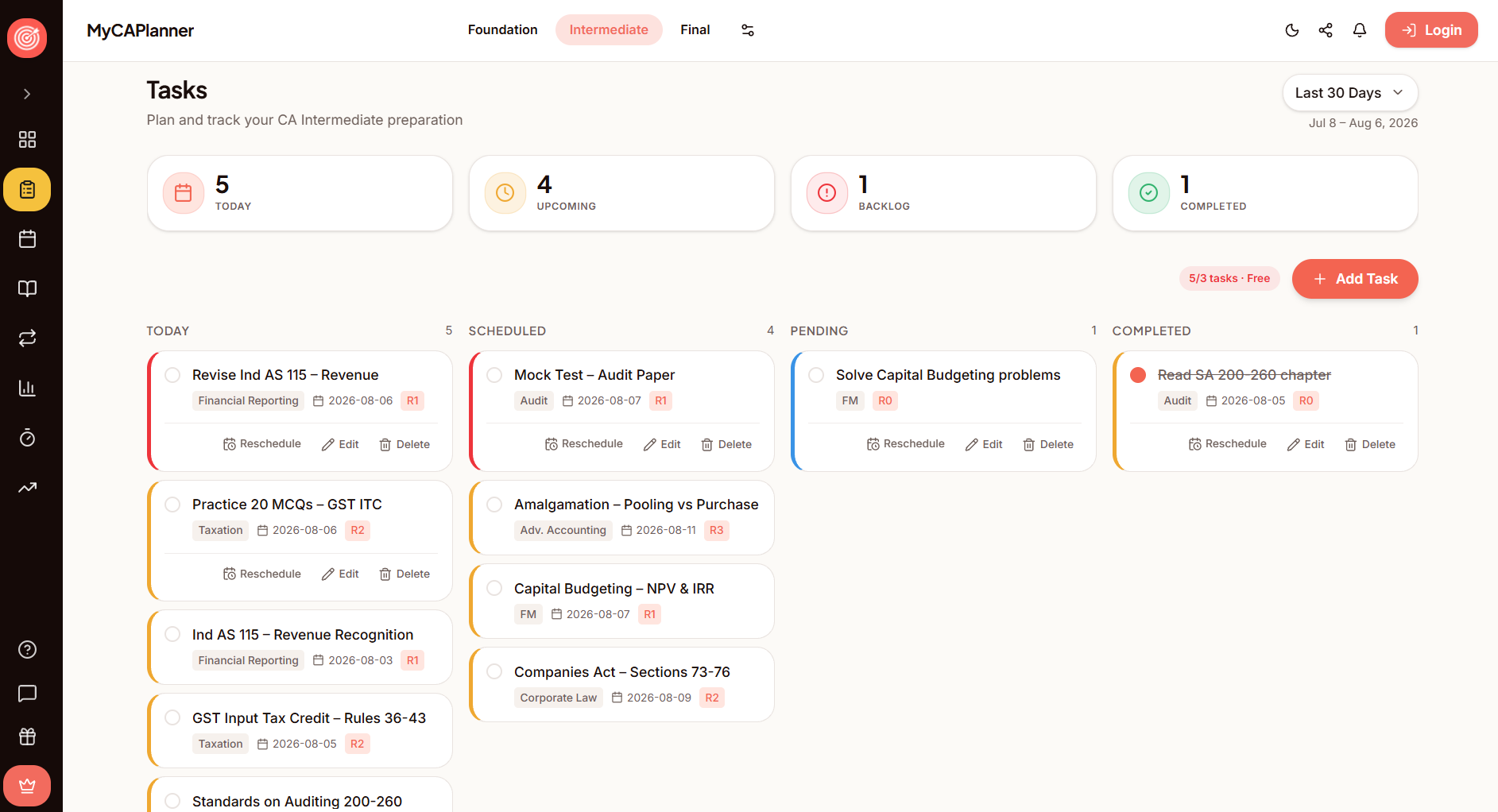
Three to five tasks per day, with one marked as the non-negotiable. If everything else collapses, that one task still gets done, and the streak survives.
Step 7 — Schedule revision at the time of learning
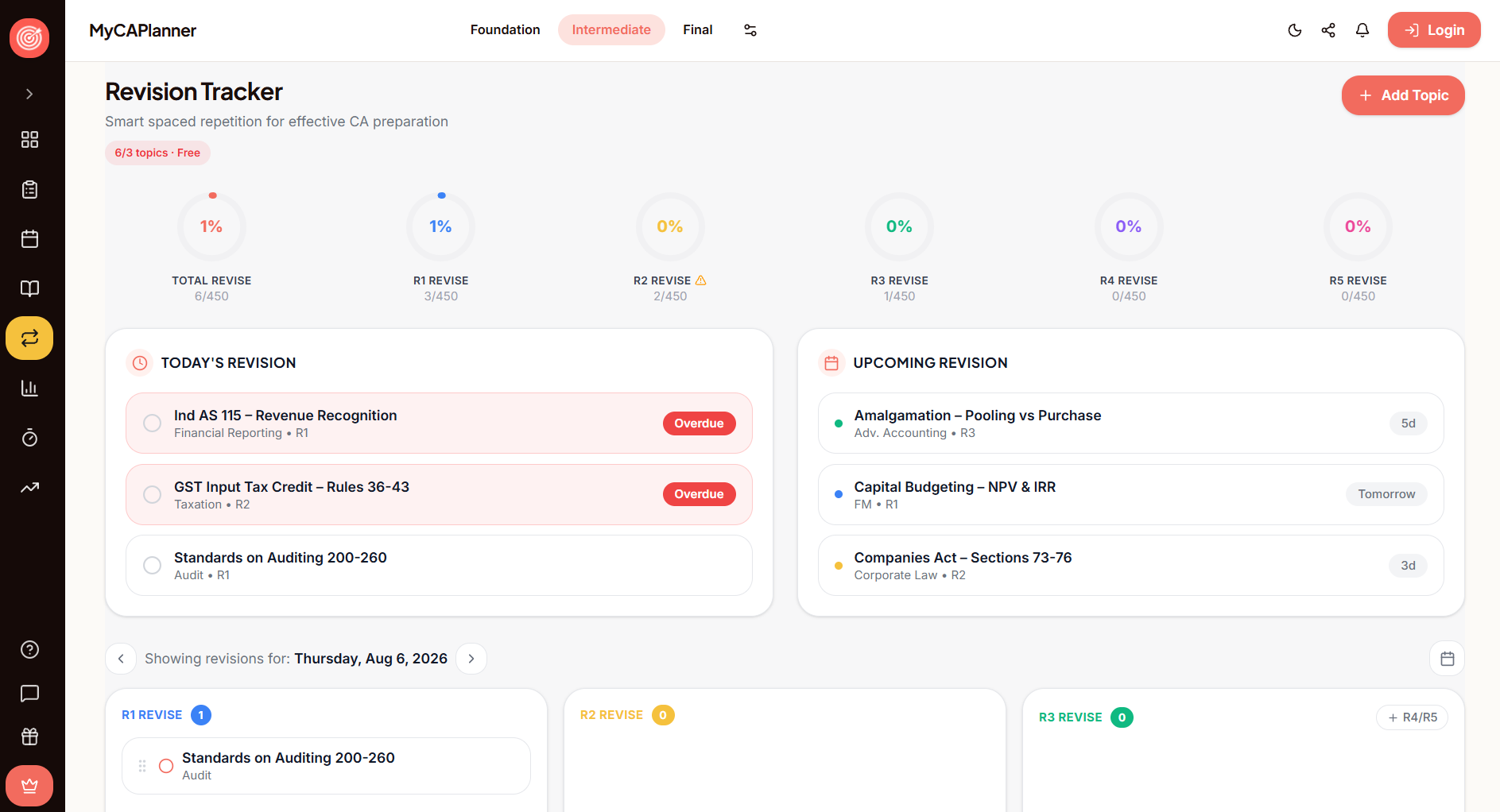
When you finish a chapter, immediately place its first revision date about 7 days out and the second about 21 days out. Revision that is scheduled later is revision that never happens.
Step 8 — Schedule question practice separately
Practice is not revision. Reserve fixed practice blocks — for example, two evenings a week for Accounts and Costing sums from ICAI material, RTPs and MTPs — so it does not get squeezed out by reading.
Step 9 — Book mock tests in advance
Put full-paper dates in the calendar before the month begins, and block the review time immediately after. A test without a booked review slot usually gets scored and forgotten.
Step 10 — Review progress every week
Thirty minutes, same time each week. Three questions: what did I complete, what slipped, and what changes next week? Look at coverage percentages, not feelings.
Step 11 — Adjust, don't rebuild
Adjustment means moving items and dropping the least valuable ones. Rebuilding means starting again, which resets your data and your momentum. Adjust weekly; rebuild at most once, when you move from the learning phase to the revision phase.
CA Intermediate subject-wise planning
The six papers under the current scheme need genuinely different handling. Below is how each behaves in a plan, based on the preparation style the paper demands rather than on chapter lists, which you should always take from the latest ICAI material.
| Paper | Preparation type | How to schedule it | What to track |
|---|---|---|---|
| Advanced Accounting (G1) | Practical, standards-driven | Daily, in your sharpest block; one concept + sums in the same session | Sums solved per chapter, accuracy, Ind AS/AS chapters revised |
| Corporate and Other Laws (G1) | Theory, section-based recall | Short daily contact plus one longer weekly written-recall session | Revision count per chapter, sections recalled without notes |
| Taxation (G1) | Mixed — computation plus provisions | Daily contact; alternate Income-tax and GST rather than finishing one entirely | Computation practice, amendment coverage, chapter revisions |
| Cost and Management Accounting (G2) | Practical, format-heavy | Daily sums; formats written by hand, not read | Sums per method, format accuracy, time per sum |
| Auditing and Ethics (G2) | Theory, high memory load | Frequent short sessions; SA-wise summaries; weekly recall | Number of passes per SA/chapter, self-test scores |
| FM and SM (G2) | Two halves: numerical (FM) + structured theory (SM) | Treat as two subjects; FM with practice blocks, SM with recall blocks | FM sums accuracy, SM answer structure and coverage |
Practical tip
Pair one practical and one theory paper in the same day. Studying Accounts and Costing back to back exhausts the same kind of attention; Accounts followed by Audit does not.
CA Intermediate Group 1 study plan
Group 1 is anchored by Advanced Accounting. Taxation is the paper that quietly consumes time because it must be kept current, and Law is the paper most likely to be under-revised.
| Day | Morning (sharp hours) | Afternoon | Evening |
|---|---|---|---|
| Monday | Advanced Accounting — new chapter | Taxation — Income-tax computation practice | Law — reading + notes |
| Tuesday | Advanced Accounting — sums | Taxation — GST provisions | Law — written recall of Monday's chapter |
| Wednesday | Advanced Accounting — new chapter | Taxation — problems | Revision: last week's Accounts chapter |
| Thursday | Taxation — new chapter | Accounts — practice set | Law — new chapter |
| Friday | Advanced Accounting — sums | Taxation — mixed problems | Law — revision pass |
| Saturday | Chapter test (one paper) | Test review + error log | Weak-topic work |
| Sunday | Buffer / catch-up | Weekly review (30 min) | Rest |
Weekly review for Group 1 should check three numbers: Accounts chapters completed against target, the count of Taxation chapters revised at least once, and whether Law has had any recall practice at all this week. The third one is where most Group 1 plans leak.
CA Intermediate Group 2 study plan
Group 2 has a different centre of gravity. Costing needs the daily practice slot that Accounts takes in Group 1, but Audit adds a heavy memory load that Group 1 does not have, and FM/SM behaves like two papers sharing one seat.
| Day | Morning (sharp hours) | Afternoon | Evening |
|---|---|---|---|
| Monday | Costing — new method + sums | FM — numerical practice | Audit — new chapter + summary |
| Tuesday | Costing — sums only | SM — chapter reading + answer structure | Audit — recall of Monday's chapter |
| Wednesday | Costing — new method | FM — new chapter | Audit — SA revision |
| Thursday | FM — sums | Costing — mixed practice | SM — written answer practice |
| Friday | Costing — variance/marginal practice | FM — revision | Audit — weak areas |
| Saturday | Full-chapter test | Review + mistake log | SM case-style writing |
| Sunday | Buffer / catch-up | Weekly review | Rest |
Two Group 2 specifics worth planning for. First, Audit rewards frequency over duration — four twenty-minute recalls in a week beat one two-hour reading. Second, SM answers are judged on structure, so practice writing them, not just reading them; a chapter you can only recognise is not a chapter you can answer.
CA Intermediate study plan for both groups
Attempting both groups is a scheduling problem more than a capacity problem. The failure mode is predictable: Group 1 gets the first three months, Group 2 gets whatever is left, and revision for Group 1 never happens because Group 2 is still incomplete.
- Touch both groups every single week from week one, even if the split is uneven.
- Use roughly 60:40 in favour of Group 1 for the first half, then move to 50:50, then to whichever group is weaker in the last month.
- Keep one paper from each group active at a time rather than running all six in parallel.
- Alternate practical papers across days — Accounts on one day, Costing the next — so both stay warm.
- Never let one group go more than 10 days without a revision touch.
- Schedule tests alternately: Group 1 paper one weekend, Group 2 the next.
| Phase | Focus split | Main activity |
|---|---|---|
| Months 1–2 | Group 1 60% / Group 2 40% | New learning, first revisions scheduled |
| Months 3–4 | 50 / 50 | Complete coverage, chapter tests, second revisions |
| Month 5 | Weaker group 60% | Full papers, mistake-driven revision |
| Final 30–40 days | Alternate daily | Rapid revision, full mocks, error log only |
Insight: revision debt
Postponed revision behaves like a loan with interest. A chapter delayed by two weeks needs a short top-up; delayed by two months it needs almost a full re-learn. Both-group students accumulate this debt faster than anyone, which is why revision must be scheduled, not squeezed in.
Group-wise progress, revision cycles and test history in a single view.
Daily CA Intermediate study plans (4, 6, 8 and 10 hours)
There is no correct number of hours. A student with 4 well-used hours and honest tracking often outperforms one with 9 unfocused hours. Use whichever of these matches your real life, and treat the structure — learning, practice, revision, review — as the part that matters.
4-hour day (articleship, job or college)
| Block | Time | Work |
|---|---|---|
| Early morning | 60 min | Practical paper — sums only, no new theory |
| Commute / gaps | 20 min | Audit or Law recall from summaries |
| Evening 1 | 75 min | New chapter learning |
| Evening 2 | 45 min | Revision of a chapter due today |
| Before sleep | 10 min | Mark progress, plan tomorrow's three tasks |
6-hour day
| Block | Time | Work |
|---|---|---|
| Morning | 2 × 60 min | Practical paper: concept + sums |
| Late morning | 45 min | Revision (scheduled chapter) |
| Afternoon | 60 min | Second paper — new learning |
| Evening | 60 min | Theory paper reading + summary |
| Night | 30 min | Written recall + tomorrow's plan |
8-hour day (full-time preparation)
| Block | Time | Work |
|---|---|---|
| 06:30–09:00 | 2.5 hrs | Hardest practical chapter + sums |
| 09:30–11:00 | 1.5 hrs | Second paper — new learning |
| 12:00–13:00 | 1 hr | Question practice from ICAI material |
| 15:00–16:30 | 1.5 hrs | Theory paper — reading and notes |
| 17:00–18:00 | 1 hr | Scheduled revision |
| 21:00–21:30 | 30 min | Recall test + plan review |
10-hour day (final phase only)
Ten-hour days are sustainable for weeks, not months, and belong to the last stretch before the exam. If you attempt them, protect two things: one full break of 60–90 minutes in the middle, and sleep. A 10-hour day followed by a 3-hour day averages worse than two steady 7-hour days.
| Block | Time | Work |
|---|---|---|
| Morning | 3.5 hrs | Full paper attempt or heavy practice |
| Midday | 1.5 hrs | Test review, mistake log, corrections |
| Break | 1.5 hrs | Meal, walk, actual rest — not phone |
| Afternoon | 2.5 hrs | Revision of two chapters |
| Evening | 2 hrs | Weak topics + theory recall |
| Night | 30 min | Tomorrow's plan |
A sample CA Intermediate weekly study plan
| Day | Primary | Secondary | Third block |
|---|---|---|---|
| Monday | New chapter — practical paper | Question practice | Theory reading |
| Tuesday | New chapter — practical paper | Revision (due chapters) | Theory recall |
| Wednesday | New chapter — second paper | Sums practice | Weak-topic work |
| Thursday | New chapter — theory paper | Practical revision | Summary writing |
| Friday | Practice-heavy day | Revision | Light reading |
| Saturday | Mock / chapter test | Test analysis (equal time) | Convert errors into tasks |
| Sunday | Buffer for missed work | Weekly review — coverage numbers | Rest |
Notice what is protected here: revision appears on four days, test analysis gets as much time as the test, and Sunday is not another study day. The buffer is not laziness — it is the reason the plan is still alive in month four.
Monthly planning
Set five numbers at the start of each month, and review them on the last day.
| Target | Example | Why it matters |
|---|---|---|
| Chapter target | 9 new chapters across 3 papers | Keeps coverage on schedule |
| Revision target | 12 chapter revisions completed | Prevents revision debt |
| Practice target | 180 sums / 40 theory questions | Converts reading into answering |
| Test target | 2 full-paper tests + 4 chapter tests | Gives objective feedback |
| Weak-area target | Close 4 recurring mistakes | Stops score plateaus |
The month-end review takes twenty minutes: compare actual against target, note the gap in one line, and set next month's numbers slightly closer to reality. Two honest months of data will predict your finish date better than any generic study schedule found online.
CA Intermediate revision planner
Revision is where Intermediate results are made. The syllabus is large enough that the first reading of a chapter is only a rough draft of knowledge.
| Pass | When | Method | Time per chapter |
|---|---|---|---|
| R1 — first revision | 5–7 days after learning | Re-solve 3–5 key sums or re-write the chapter skeleton | 30–45 min |
| R2 — second revision | 21–30 days later | Summary notes + past questions, no re-reading of full text | 20–30 min |
| R3 — final revision | Last 30–45 days | Rapid pass over notes, formats and your mistake log | 10–20 min |
| R4 — weak-chapter pass | As needed | Only chapters that failed a test or a recall check | Variable |
| R5 — exam-week pass | Final 7 days | Formats, sections, formulas, amendment points | 5–10 min |
Two rules make revision work. First, revise actively — close the book and reproduce, then check. Re-reading feels efficient and is the least effective option available. Second, revise on schedule rather than by mood, because the chapters you avoid are precisely the ones needing the pass.
Mistake-based revision deserves its own slot. Keep a single running list of errors from tests and practice — wrong treatment, forgotten disclosure, missed section, calculation slip — and revise that list weekly. It is the shortest document in your preparation and the highest-yield one.
Mock tests and test analysis
Mock tests measure three separate things: whether you know the material, whether you can present it, and whether you can finish in time. Most students only measure the first, then wonder why the score does not move.
- Chapter-level tests from the first month — 30 to 45 minutes, closed book.
- Full-paper tests once a paper crosses roughly 70% coverage.
- Full three-hour mocks in the last 6 to 8 weeks, written at the same time of day as the real paper.
- Always hand-written, always timed, always with the same stationery you will carry.
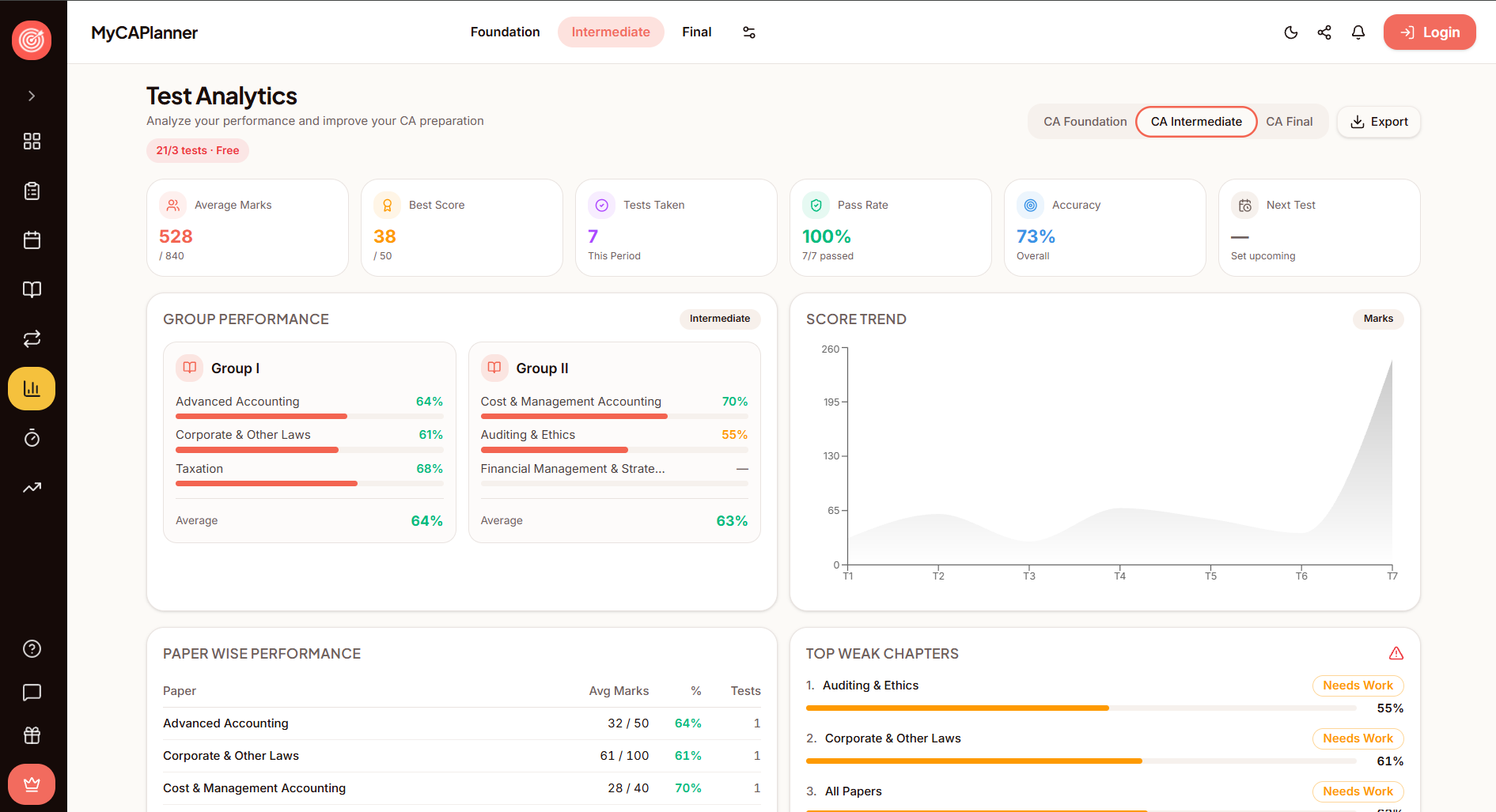
Then analyse. Spend at least as long reviewing as you spent writing, and record each test in a table like this:
| Test | Score | Accuracy | Weak area | Mistake type | Action | Next test |
|---|---|---|---|---|---|---|
| Adv. Accounting MTP 1 | 48/100 | 62% | Amalgamation | Concept gap | Re-learn + 10 sums | Retest in 10 days |
| Taxation Ch. test | 31/50 | 71% | Capital Gains exemptions | Recall failure | Summary card + weekly recall | Included in next full paper |
| Costing full paper | 55/100 | 68% | Process costing | Calculation slips | 20 timed sums, accuracy focus | Retest in 2 weeks |
| Audit chapter test | 22/40 | 55% | SA 700 series | Presentation | Point-format answer practice | Retest in 7 days |
| FM/SM full paper | 51/100 | 64% | Capital structure + SM structure | Time management | Write 3 answers under 12-min limit | Next weekend |
Insight: the analysis gap
The most common preparation leak at Intermediate level is a folder of scored papers with no tasks generated from them. A test is not finished when it is marked; it is finished when at least three dated study tasks exist because of it.
Syllabus tracking (and why percentages can mislead)
A syllabus tracker converts a vague sense of progress into a number you can act on. Track each paper at topic level with four states.
| Paper | Completed | In progress | Revised | Pending |
|---|---|---|---|---|
| Advanced Accounting | 18 topics | 3 | 11 | 9 |
| Corporate & Other Laws | 14 | 2 | 5 | 13 |
| Taxation | 22 | 4 | 9 | 16 |
| Cost & Management Accounting | 16 | 2 | 8 | 12 |
| Auditing & Ethics | 9 | 1 | 3 | 18 |
| FM & SM | 12 | 3 | 4 | 17 |
Insight: 60% complete is not 60% ready
Coverage and readiness are different measurements. A student at 60% coverage with zero revision is far less prepared than one at 45% coverage with two revision passes and four tests. Read your tracker as three numbers — studied, revised, tested — and let the smallest one set your true position.
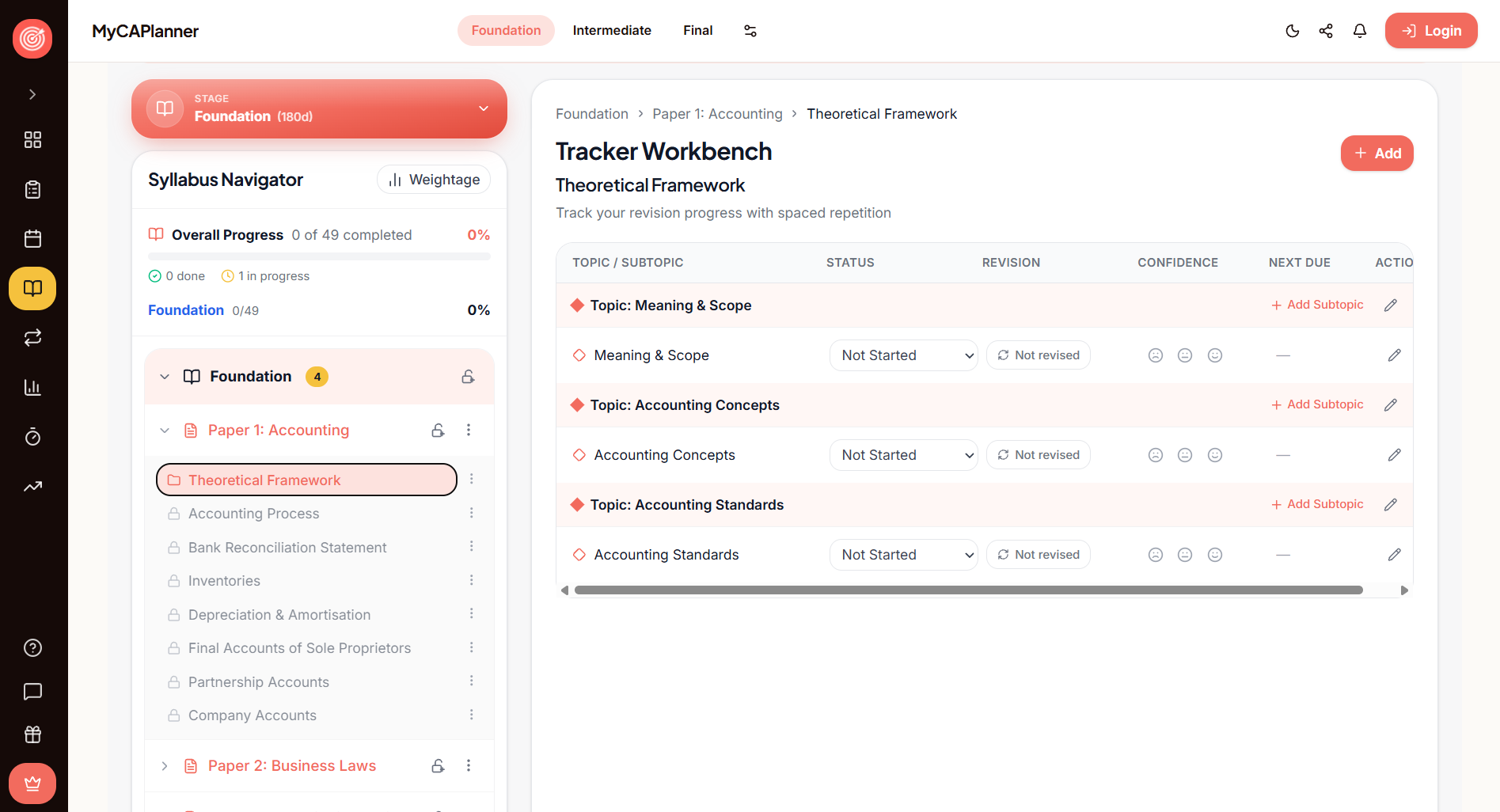
How MyCAPlanner helps
Everything above can be done with a notebook. The reason students eventually move to a tool is that the record-keeping becomes the hard part. Here is how MyCAPlanner maps to the specific problems described on this page.
| The problem you actually have | What handles it |
|---|---|
| "I don't know how much of my syllabus is genuinely complete." | Syllabus Tracker — Foundation, Intermediate and Final syllabi built in, tracked at chapter and topic level |
| "My weekly goals never become daily work." | Study Planner and Daily Tasks — weekly targets broken into dated tasks with a today / upcoming / backlog board |
| "I forget which chapters are due for revision." | Revision Tracking — each chapter carries its own revision cycle and due dates |
| "I can't see my month at a glance." | Calendar — tasks, tests and revision dates in one view, reschedulable |
| "I sit for two hours and study for forty minutes." | Pomodoro Timer — focused sessions logged against subjects, so study time is measured, not estimated |
| "I'm consistent for four days and then stop." | Habit Tracker — daily streaks for the few habits that carry preparation |
| "My mock scores don't improve." | Test Analysis — score, accuracy, weak areas and mistake types recorded per test |
| "I don't know if I'm ahead or behind." | Progress Analytics and Dashboard — coverage, study hours, revision status and test trends together |
| "I study on my phone in the evening and laptop on weekends." | Mobile-friendly web app with cloud sync — same data on every device once signed in |
You can see the daily side on the dashboard, read more preparation guides on the blog, compare plans on the pricing page, or start with the CA Foundation study planner guide if you are helping a junior plan their first level.
The workflow: plan, study, track, revise, test, adjust
| Stage | When | What you do |
|---|---|---|
| Plan | Sunday evening, 30 min | Set weekly chapter, revision and practice targets |
| Study | Daily | Work through 3–5 dated tasks; one is non-negotiable |
| Track | End of each session | Mark topics studied; log focused minutes |
| Revise | Daily, small slot | Clear whatever revision is due today |
| Test | Weekly | One chapter or full paper under timed conditions |
| Analyse | Immediately after the test | Log score, accuracy, weak area, mistake type |
| Adjust | Sunday review | Move slipped items, drop the least valuable, reset targets |
| Repeat | Every week | The loop is the plan; the timetable is only a detail |
Notebook vs Excel vs to-do app vs study planner
All of these work. They differ in how much effort they need to stay accurate over six months, which is the only thing that matters at Intermediate level.
| Notebook | Excel / Sheets | Generic to-do app | MyCAPlanner | |
|---|---|---|---|---|
| Setup effort | Lowest | High — you build everything | Low | Low — CA syllabus pre-loaded |
| Syllabus tracking | Manual, easily outdated | Good if maintained | Not designed for it | Chapter and topic level |
| Daily planning | Good | Clumsy on phone | Excellent | Built around it |
| Revision cycles | Manual dates | Formula-dependent | Repeating tasks only | Per-chapter cycles |
| Test analysis | Manual table | Strong if you build it | Not supported | Built in with trends |
| Progress visibility | Low | Depends on your charts | Task counts only | Coverage + revision + tests |
| Updating on the move | Not possible | Painful | Easy | Easy |
| Risk of loss | Physical loss | File versions | Low | Cloud-synced account |
If you enjoy building spreadsheets and will genuinely maintain one, Excel is a perfectly good CA Intermediate study planner. Most students find that maintenance is the first thing to go in a busy week — which is the argument for something purpose-built.
Free plan includes daily tasks, habits, focus timer and syllabus tracking.
How to stay consistent for six months
- Set targets you have already hit at least once. Ambition belongs in month three, not week one.
- Plan tomorrow before sleeping — three tasks, written down. Morning decisions cost willpower.
- Fix your first study block at the same time daily so starting stops being a choice.
- Keep one non-negotiable task per day. On bad days, that alone keeps the chain intact.
- Review weekly, not daily. Daily reviews turn into daily plan edits.
- Never rebuild the plan after a bad day. Move the item and continue.
- Keep a buffer slot every week; use it for slippage, not extra work.
- Track completed work visibly — a streak or a rising coverage number is a real motivator.
- Do revision before new learning on low-energy days; it is easier and still valuable.
- Protect focus: phone in another room during practical sessions.
- Use a timer. Twenty-five focused minutes is a smaller commitment than "study Costing".
- Keep one genuine rest block a week. Preparation collapses from exhaustion more than from laziness.
- Study weak subjects when you are fresh, not as punishment at midnight.
- Log mistakes in one place and revise that list weekly.
- Avoid comparing your coverage with other students; compare with your own plan.
- Restart the same day you break, not next Monday. Waiting for a clean start costs six days.
Insight: momentum is built from finished small tasks
Students who sustain long preparation are rarely the most motivated. They are the ones whose daily plans were small enough to finish, which produced a visible record of completion, which made the next day easier to start.
What to do when you fall behind
You will fall behind. Everyone does. The difference is in the recovery, and panic recovery — the eighteen-hour day, the complete plan rewrite — usually costs more than the original delay.
| Step | Action |
|---|---|
| 1. Stop and count | Write the exact number of chapters remaining per paper. Vague fear is worse than a bad number. |
| 2. Recalculate capacity | Days left × realistic daily hours. This gives you what is actually possible. |
| 3. Rank what remains | By exam weight and by how close each chapter is to completion. Nearly-finished chapters first. |
| 4. Cut deliberately | Drop the lowest-value remaining topics on purpose, in writing, rather than by accident. |
| 5. Protect revision | Reduce new learning before you reduce revision. Half-remembered chapters score nothing. |
| 6. Use catch-up blocks | Move missed items into buffers over two weeks, not into tomorrow. |
| 7. Rebuild once | One clean re-plan, then stop editing and start executing. |
| 8. Restart with one task | The first day back needs one completed task, not a perfect day. |
An example CA Intermediate study dashboard
Here is what a student's numbers might look like about three months before the exam, and how to read them.
| Metric | Value | How to read it |
|---|---|---|
| Overall syllabus coverage | 54% | On track only if revision is keeping pace — check the next rows |
| Advanced Accounting | 67% | Healthy; shift some time to weaker papers |
| Auditing & Ethics | 43% | Behind, and memory-heavy — needs frequency, not one long push |
| Taxation | 58% | Fine on coverage; verify amendment topics are included |
| Revision completed | 31% | The real bottleneck. Revision is lagging coverage by 23 points |
| Tests completed | 8 | Reasonable count — the question is whether each produced tasks |
| Weak areas open | 5 | Should be closing at 1–2 per week from here |
| Average focused hours/day | 5.2 | Consistent; better to protect this than to chase 8 |
The correct reading of this dashboard is not "54% done". It is "coverage is fine, revision is the problem, and Audit needs daily contact starting this week". That is the kind of decision a tracker exists to make possible.
15 common CA Intermediate study mistakes
| Mistake | Why it happens | Do this instead |
|---|---|---|
| Studying without a chapter list | The syllabus feels familiar from coaching | Write the full chapter list per paper before week one |
| Leaving Audit and Law for the end | Theory feels easy to catch up | Start both in month one with short daily contact |
| Reading instead of solving | Reading feels productive and is comfortable | Every practical session ends with sums attempted alone |
| Perfectionism on one chapter | Fear of moving on with gaps | Cap time per chapter; mark gaps and return in revision |
| Constant subject switching | Boredom and anxiety | One paper per block, minimum 60 minutes |
| No revision schedule | Revision has no deadline | Fix R1 and R2 dates the day you finish a chapter |
| Skipping ICAI material | Coaching notes are shorter | Use notes for learning, ICAI material for practice |
| Ignoring amendments in Tax and Law | Old notes are reused | Verify applicability for your attempt from ICAI |
| Taking tests only at the end | Fear of low scores | Chapter tests from month one; low early scores are information |
| Not analysing tests | Review is unpleasant | Book the review slot when you book the test |
| Copying someone else's timetable | It looks disciplined | Build around your actual available hours |
| Over-editing the plan | Planning feels like progress | One review slot per week, nothing else |
| Studying tired and calling it dedication | Hours are treated as the metric | Measure focused minutes, protect sleep |
| Both groups without weekly balance | Group 1 feels more urgent | Touch both groups every week from day one |
| Restarting the plan after a bad week | Desire for a clean slate | Move slipped items into buffers and continue |
CA Intermediate study planning checklist
Before you start
- Chapter list written for every paper you are attempting
- Group decision made and defended by available hours
- Exam date set and weeks counted backwards
- Session estimates recorded per chapter (+30% buffer)
- Weekly review time fixed in the calendar
Every morning
- Read today's three to five tasks
- Identify the non-negotiable one
- Start the first block at the fixed time
Every evening
- Mark topics studied and revised
- Add any new mistakes to the error log
- Write tomorrow's tasks before sleeping
Every week
- Compare completed against planned
- Check that both groups (or all papers) were touched
- Confirm revision kept pace with new learning
- Move slipped items into the buffer, drop the rest deliberately
Every month
- Review the five monthly targets
- Recalculate the finish date
- Reset targets closer to your real pace
Before and after mock tests
- Before: three-hour slot booked, review slot booked, materials ready
- After: score, accuracy, weak area and mistake type recorded
- After: at least three dated tasks created from the paper
Before the exam
- Final 30–45 days reserved for revision and testing
- Mistake log revised at least three times
- Formats, sections, formulas and amendments in a single rapid-revision document
- Sleep schedule matched to exam timings for the last two weeks
Free to start — add revision cycles and test analytics whenever you need them.
CA Intermediate study planner — frequently asked questions
What is the best CA Intermediate study planner?
The best planner is the one that survives a bad week. Practically, that means it must hold three things at once: syllabus coverage at chapter level, dated daily tasks, and revision history. A planner that only shows today's tasks will not tell you in March whether Group 2 is quietly falling behind. MyCAPlanner was built around that gap, and its free plan is enough to test the habit before paying anything.
How do I make a CA Intermediate study plan?
Work backwards from the exam date. List every chapter of the papers you are attempting, estimate sessions per chapter, divide the available weeks into learning weeks and revision weeks, then convert each week into three to five daily tasks. Keep one buffer day every week and review coverage every Sunday.
How many hours should I study for CA Intermediate?
Full-time students usually settle between 7 and 9 focused hours. Students in articleship or working typically manage 3 to 4 hours on weekdays and 8 on weekends. Focused hours count; hours with the phone on the desk do not. Track focused time rather than time at the desk and the number becomes honest.
How should I plan CA Intermediate Group 1?
Give Advanced Accounting the largest and freshest block of your day because it is practice-heavy. Pair it with Taxation, which needs steady daily contact rather than long weekend marathons, and keep Corporate and Other Laws for evening reading plus weekly written recall.
How should I plan CA Intermediate Group 2?
Cost and Management Accounting behaves like Accounts and needs daily sums. Auditing and Ethics is memory-heavy and rewards short, frequent contact. FM and SM is split — FM needs numerical practice, SM needs structured recall — so treat them as two subjects inside one paper when you plan.
Can I prepare for both groups together?
Yes, and many students do, but only if the weekly plan touches both groups every week. The common failure is spending three months on Group 1, then discovering Group 2 has no revision time left. A both-groups plan should allocate roughly 60:40 early on and move to 50:50 in the last two months.
How do I track my CA Intermediate syllabus?
Break each paper into chapters, then into topics, and mark each topic separately as studied, revised and tested. Percentage completion should be calculated from topic counts, not from how you feel about a subject.
How often should I revise CA Intermediate subjects?
Three passes is the working minimum: one within a week of learning, one about three weeks later, one in the final month. Weak chapters usually need a fourth or fifth pass, which is why revision counts should be tracked per chapter and not per subject.
How many mock tests should I take for CA Intermediate?
Chapter-level tests from the first month, full-paper tests once a paper crosses roughly 70% coverage, and six to ten full three-hour papers per group in the final eight weeks. The analysis matters more than the count.
How should I analyse CA Intermediate mock tests?
Score first, then spend at least as long on review as you did on the paper. Classify every lost mark as a concept gap, a presentation issue, a calculation slip or a time problem — the fix is different for each. Then convert each gap into a dated study task.
What is the best CA Intermediate timetable?
One that plans about 70% of your available hours. The remaining 30% absorbs travel, office work, illness and slow chapters. Rigid 100% timetables collapse in the second week and take your confidence with them.
Can I prepare for CA Intermediate along with college or articleship?
Yes. Students who manage it protect two fixed slots — usually early morning and late evening — instead of searching for free time each day. Weekends carry the heavy practical papers.
Is MyCAPlanner free?
There is a free plan covering daily tasks, habits, the focus timer and basic syllabus tracking. Paid plans start at ₹199 for one month and unlock unlimited tracking, full revision cycles and test analytics. Pricing details are on the pricing page.
Can I use MyCAPlanner on mobile?
Yes. It runs in the browser on phone, tablet and laptop, and your data syncs across devices once you are signed in.
How does a syllabus tracker actually help?
It removes guesswork. Instead of believing Taxation is 'almost done', you see that 41 of 58 topics are studied, 12 revised and 5 tested. That single view usually changes what a student studies the next morning.
What should I do if I fall behind my study plan?
Do not rebuild the whole plan. Count the remaining chapters, move only the missed items into your buffer slots, drop low-weight topics if needed, and protect revision even if new learning shrinks. Restarting a plan from scratch is the most common way to lose a week.
How should I divide practical and theory subjects?
Practical papers in your sharpest hours, theory in the hours when reading is still possible but heavy calculation is not. Most students find practical work suits mornings and theory suits evenings, but the rule is to match subject to energy, not to clock.
How do I plan revision before the CA Intermediate exams?
Reserve the last 35 to 45 days almost entirely for revision and testing. Split it into a full syllabus pass, a weak-topic pass and a final rapid pass over summaries, past questions and your own mistake list.
Is self-study enough for CA Intermediate?
For many students, yes, provided coverage is tracked. Self-study fails when nobody is checking what is finished and what is untouched, which is precisely what a syllabus tracker replaces.
How can I stay consistent during CA Intermediate preparation?
Keep daily targets small enough to finish, review weekly instead of daily, never edit the plan on a bad day, and protect one rest block a week. Consistency comes from finishing small plans repeatedly, not from heroic days.
Should I study a new chapter or revise when I have limited time?
Early in the cycle, favour new learning; in the final two months, favour revision. A useful rule is to never let untested chapters exceed the number of chapters you can realistically revise in the time left.
Does MyCAPlanner support CA Foundation and Final too?
Yes. Foundation, Intermediate and Final syllabi are built in, and you switch levels inside the app without losing earlier data.
Keep going
A plan is only useful once it is written down and tracked. Set up your papers, mark your first chapters, and let the tracker hold the record for the next six months.