
On this page
- What is a CA Final study planner?
- Why CA Final is hard to plan
- Why most timetables fail
- How to create your study plan
- Paper-wise planning
- Group 1 study plan
- Group 2 study plan
- Both groups study plan
- Planning during articleship
- Study leave plan
- Daily plans (3–11 hours)
- Weekly plan
- Monthly roadmap
- Revision planner
- Mock tests & case practice
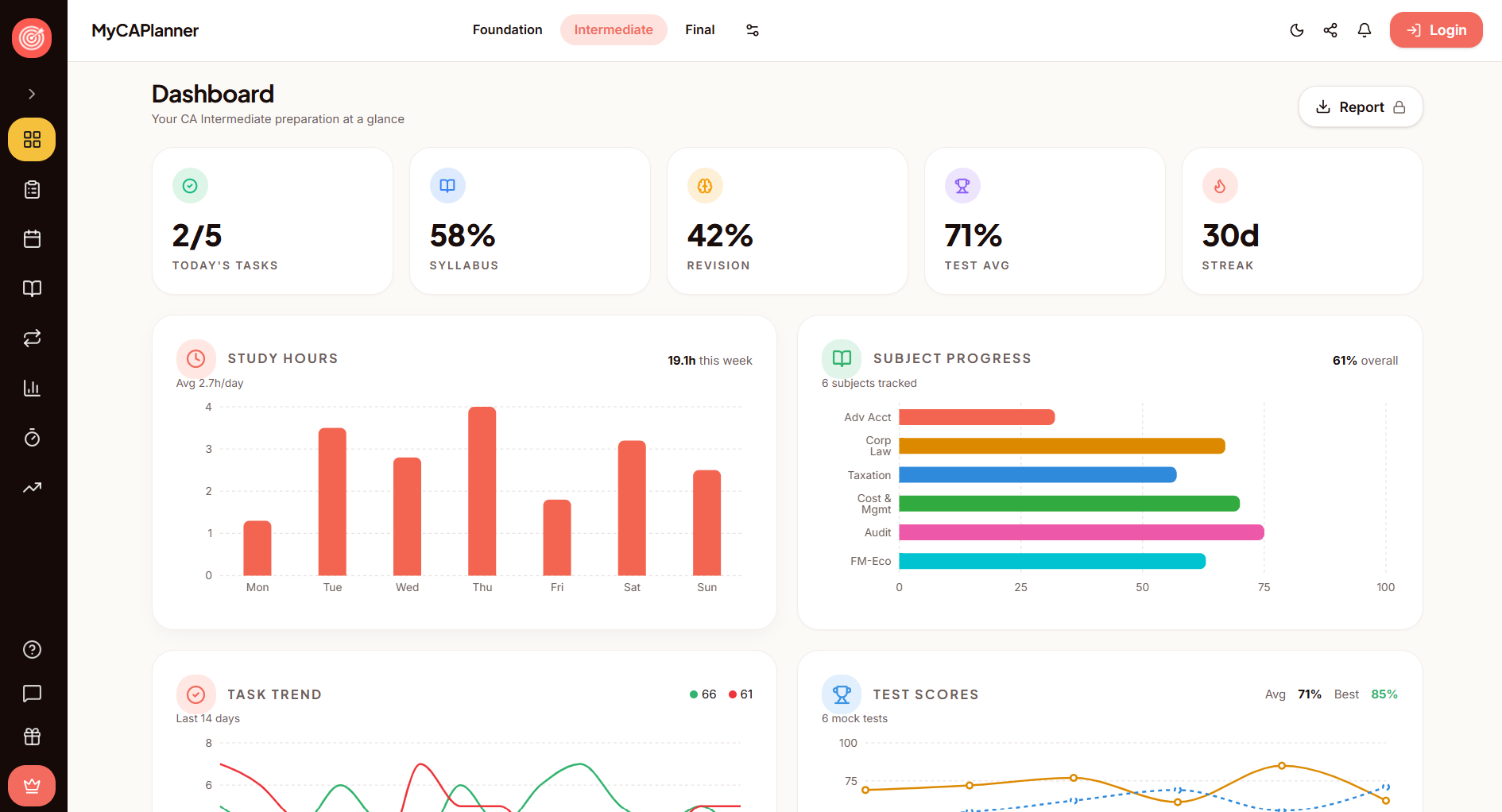
- Syllabus tracking
- How MyCAPlanner helps
- The weekly workflow
- Notebook vs Excel vs app
- Staying consistent
- When you fall behind
- 15 common mistakes
- Planning checklist
- 20+ questions answered
What is a CA Final study planner?
A CA Final study planner is a system that converts the ICAI Final syllabus into dated, chapter-level work and then keeps a record of what happened to each chapter — studied, revised, practised, tested. That last part is what separates a planner from a timetable, and at Final level it is the part that decides results.
Most candidates build the wrong tool and then blame their discipline when it stops working. The distinction is worth being precise about.
| Tool | What it answers | Where it stops |
|---|---|---|
| Timetable | What am I studying at 7 a.m. tomorrow? | Says nothing about total coverage or revision |
| To-do list | What is pending right now? | Forgets a task the moment it is ticked |
| Study planner | What should I study this week, and why that? | Needs tracking to stay honest |
| Progress tracker | How much of the syllabus is truly done? | Doesn't tell you what to do today |
| Revision planner | Which chapters are due for their next pass? | Only useful if learning is tracked first |
CA Final needs all five working together. The exam does not test what you once read; it tests what you can reproduce under time pressure, often ten or twelve months after the first reading, while your working memory is occupied by audits, filings and client deadlines.
Insight: coverage is not readiness
Ind AS 115 read once in June and never revisited is not a completed chapter in November — it is an untested one. A planner that only counts completion will overstate your readiness for months, and the correction usually arrives in the first full mock, far too late to be comfortable.
Why CA Final preparation is difficult to plan
Final is the level where planning failure is most expensive, because the constraint is rarely intelligence — it is time, decay and volume, all at once.
- Most of the preparation happens during articleship, where your best hours already belong to someone else.
- The syllabus is too large to hold in your head. By week four you genuinely will not remember which Direct Tax chapters you covered.
- Paper types differ sharply. FR and AFM need long practice blocks; Audit and Law-heavy content needs repeated recall; Tax needs daily contact.
- Amendments move under your feet. A Tax chapter finished in month two may need re-reading before the attempt.
- Theory decays fast. Standards on Auditing read once are close to gone four months later without a deliberate pass.
- Question practice competes with new learning for the same hours, and new learning usually wins — which is the wrong outcome at Final level.
- Full papers need three uninterrupted hours plus review time, and articleship weeks rarely offer that by accident.
- Paper 6 is an application paper. It cannot be crammed; it has to be rehearsed.
- Repeat attempts need a different plan from first attempts, because coverage exists but reliability does not.
Why most CA Final timetables fail
Almost every failed plan fails for the same handful of reasons, and none of them are about motivation.
- They plan 100% of available hours, so a single late night at office breaks the entire week.
- They are built in hours, not in chapters, so a productive-feeling week can end with nothing finished.
- They ignore revision until the last month, by which point the first three months have already decayed.
- They assume equal difficulty across papers, when FR and DT routinely take twice the time of their neighbours.
- They have no record, so nobody can answer 'what is actually pending?' without a long, anxious recount.
- They are rebuilt every time they break, which converts one lost day into one lost week.
Mistake: planning the ideal week
Plan the week you actually have. If Tuesdays are audit-visit days, Tuesday gets forty minutes of revision, not four hours of Financial Reporting. A plan that only works on perfect days is a plan that works about six days a month.
How to create your CA Final study plan step by step
The process below takes about ninety minutes once and then costs you fifteen minutes a week to maintain.
- Fix the attempt date and count the exact number of weeks remaining. Not months — weeks.
- Decide the group strategy: Group 1 only, Group 2 only, or both. Everything downstream depends on this.
- List every chapter of every paper you are attempting. Do not compress a paper into 'Tax'.
- Estimate sessions per chapter, honestly. Ind AS on financial instruments is not one session.
- Split the runway into three phases: learning, consolidation, and revision plus testing.
- Reserve the last 35 to 45 days for revision and full papers before allocating anything else.
- Assign chapters to weeks, keeping the heaviest papers in your strongest slots.
- Convert each week into three to five dated daily tasks, not vague subject blocks.
- Leave one buffer day per week and one buffer week per phase.
- Schedule revision passes at the moment you finish a chapter, not later.
- Review every Sunday: what moved, what slipped, what gets rescheduled.
Paper-wise planning for CA Final
Each paper behaves differently. Planning them identically is the fastest way to end up strong in two papers and exposed in four.
| Paper | Nature | How to plan it |
|---|---|---|
| Paper 1: Financial Reporting | Practical, Ind AS heavy | Longest, freshest blocks. Work problems on paper, not by reading solutions. Consolidation and financial instruments need repeat passes. |
| Paper 2: Advanced Financial Management | Numerical, formula-driven | Short daily practice beats weekend marathons. Maintain a formula sheet and re-derive rather than memorise. |
| Paper 3: Advanced Auditing, Assurance & Professional Ethics | Theory, standards heavy | Frequent short contact plus weekly written recall of standards and ethics schedules. |
| Paper 4: Direct Tax Laws & International Taxation | Provision heavy, amendment sensitive | Daily contact. Attach an amendment task each week and practise through questions, not summaries. |
| Paper 5: Indirect Tax Laws | GST and Customs, procedural | Chapter-wise questions immediately after reading. Keep charts for time, place and value of supply. |
| Paper 6: Integrated Business Solutions | Multidisciplinary case study | Practise full cases under time from the consolidation phase. Preparation is rehearsal, not new reading. |
Tip: match subject to energy, not to clock
Practical papers belong in your sharpest hours; theory belongs in the hours where reading is still possible but heavy computation is not. For most articled assistants that means FR and AFM early morning or weekend, Audit and Law in the evening, and Tax split across both.
CA Final Group 1 study plan
Group 1 is dominated by Financial Reporting. If FR is not under control, nothing else in the group feels stable.
| Slot | Weekday (articleship) | Weekend |
|---|---|---|
| Morning | FR problems — 60 to 90 minutes | FR — 3 hours of fresh problems |
| Commute / gaps | Audit standards recall, flashcards | — |
| Evening | AFM numericals or Audit reading — 90 minutes | AFM practice — 2 hours |
| Night | Fifteen-minute recall of the day's chapter | Weekly review and next-week planning |
- Give FR the first block of the day, every day, even on weak days.
- AFM needs frequency more than duration — thirty honest minutes daily outperforms one four-hour Sunday.
- Audit rewards writing. Once a week, write a standard from memory and compare.
- Every finished chapter gets an immediate first revision date and one practice set.
CA Final Group 2 study plan
Group 2 is a tax-heavy group with an application paper attached. The failure mode is treating Paper 6 as an afterthought.
| Slot | Weekday (articleship) | Weekend |
|---|---|---|
| Morning | Direct Tax — 60 to 90 minutes | DT problems and case-based questions — 3 hours |
| Commute / gaps | GST charts and provisions recall | — |
| Evening | Indirect Tax chapter plus questions — 90 minutes | IDT practice — 2 hours |
| Weekend extra | — | One integrated case study under time |
- DT and IDT both need daily contact; alternating them weekly causes heavy relearning.
- Keep a running amendment list per chapter and revisit it every fortnight.
- Paper 6 practice starts the moment two other papers are reasonably covered, not in the last month.
- Open book only helps if you have rehearsed locating information quickly; otherwise it costs time.
Attempting both groups together
Both groups is a viable strategy and a common one, but only with a weekly plan that touches both groups every week.
| Phase | Group 1 : Group 2 split | Focus |
|---|---|---|
| Articleship months | 60 : 40 | Cover FR, AFM and DT first; keep Audit and IDT ticking |
| Early study leave | 55 : 45 | Finish remaining chapters, start full-paper tests |
| Last two months | 50 : 50 | Revision passes and alternating full papers from both groups |
| Last 15 days | Alternate by day | Rapid revision, summaries, mistake list, past questions |
Mistake: sequential groups
Spending four straight months on Group 1 and then starting Group 2 leaves Group 1 stale and Group 2 unrevised. Whatever the ratio, both groups should appear in every single week of the plan.
Planning CA Final during articleship
Articleship is not an obstacle to planning; it is the reason a plan is needed. Candidates who manage it protect fixed slots instead of hunting for free time.
- Two protected slots beat five optimistic ones: usually 5:30–7:30 a.m. and 9:30–11 p.m.
- Weekdays carry theory and short numericals; weekends carry long practical papers.
- Busy season is planned for in advance — reduce targets deliberately rather than failing them silently.
- Commute and waiting time is real study time for recall, flashcards and provision revision.
- Set a weekly minimum you can hit even in the worst week. Hitting a small target keeps the streak alive.
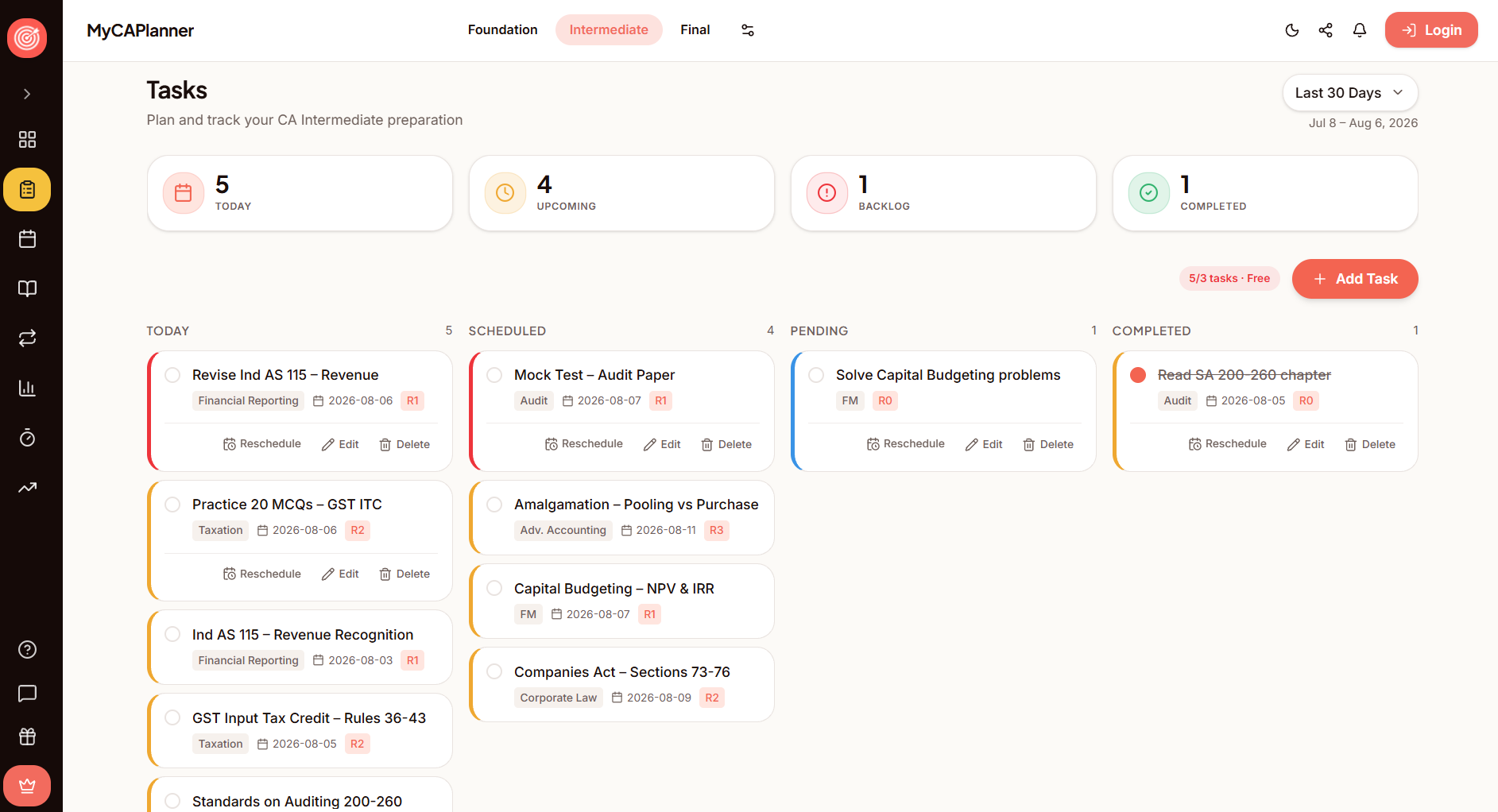
Track chapters, tasks and revision cycles across all six Final papers.
Study leave plan
Leave is best spent consolidating, revising and testing. If you meet Transfer Pricing or Ind AS 110 for the first time during leave, the schedule is already under strain.
| Leave period | Primary work | Testing |
|---|---|---|
| First 30% | Close remaining chapters, first revision pass | Chapter tests, two full papers |
| Middle 40% | Second revision pass, heavy question practice | One full paper every week |
| Last 30% | Third pass, summaries, mistake list, amendments | Two full papers a week, alternating groups |
Daily study plans from 3 to 11 hours
The right daily plan is the one that matches your current life, not the one you saw on social media.
| Available time | Split | Notes |
|---|---|---|
| 3 hours (busy office day) | 1h practical + 1h theory + 1h revision/questions | Protect revision first; it is the part that silently disappears |
| 4–5 hours (normal articleship day) | 2h practical + 1.5h theory + 1h revision | Practical work goes in the earliest slot |
| 7–8 hours (weekend) | 3h practical + 2h theory + 1.5h questions + 1h revision | Include one long problem set without breaks |
| 9–11 hours (study leave) | 4h practical + 2.5h theory + 2h questions + 1.5h revision | Insert a full paper twice a week in place of the question block |
Tip: plan 70% of your hours
Leave 30% unplanned. Chapters overrun, office overruns, and health does not consult your timetable. The unplanned third is what keeps the planned two-thirds credible.
The weekly plan
- Six working days plus one lighter buffer day; the buffer day absorbs whatever slipped.
- Every paper you are attempting appears at least twice in the week.
- One written test — chapter level early, full paper later.
- One revision block of at least two hours for chapters due their next pass.
- A fifteen-minute Sunday review: what moved, what slipped, what changes next week.
A month-by-month roadmap
| Stage | Goal | Signal you are on track |
|---|---|---|
| Months 1–3 (articleship) | Cover the heaviest papers first | FR and DT at 50%+ coverage |
| Months 4–6 | Complete remaining chapters, start second passes | All papers started, none untouched |
| Study leave, first half | Close the syllabus, begin full papers | Every chapter studied at least once |
| Study leave, second half | Revision cycles and testing | Two revisions on most chapters |
| Last 45 days | Rapid passes, mocks, mistake list | Eight or more full papers written |
The revision planner
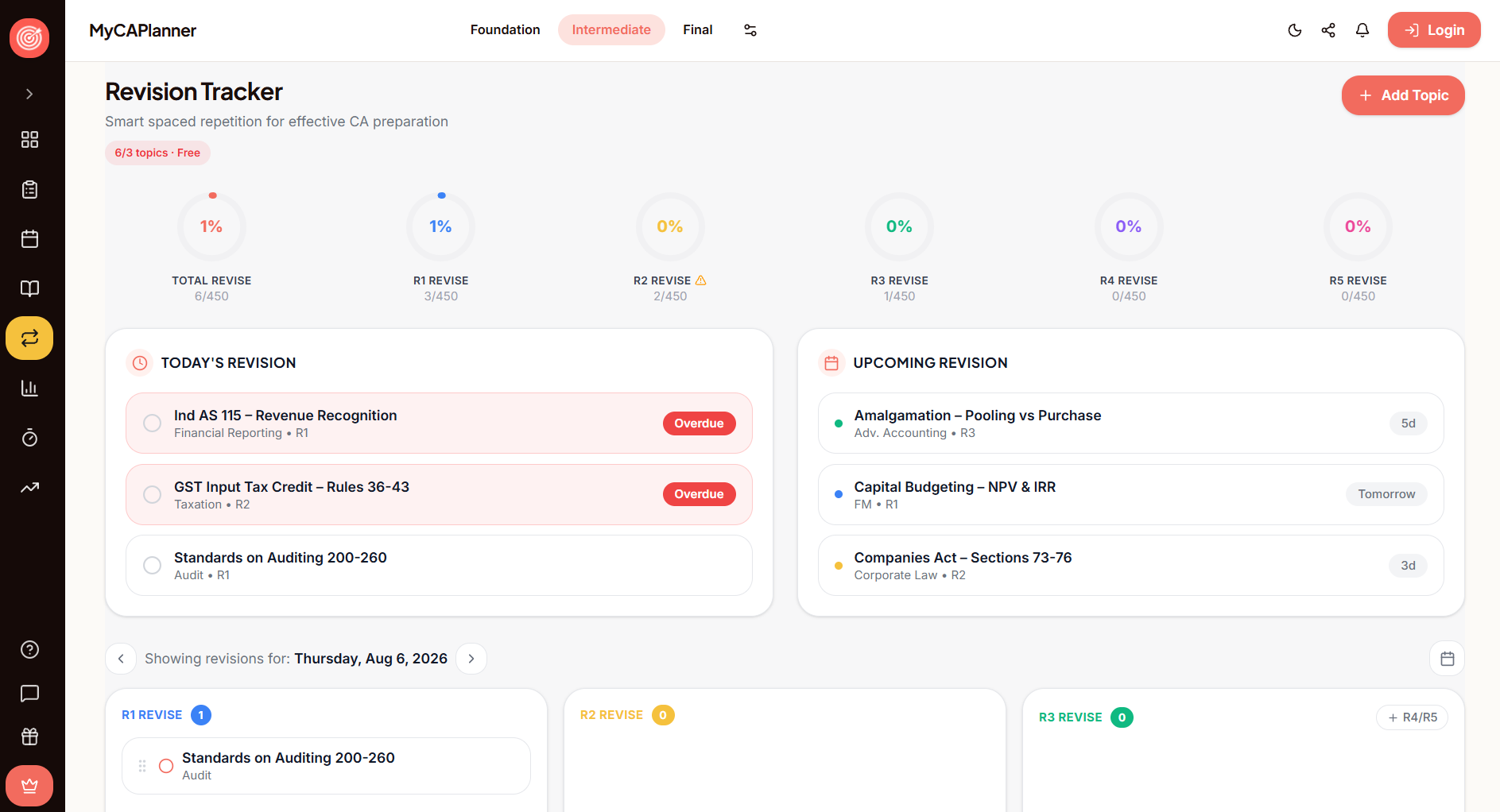
Revision is the difference between coverage and marks. The workable minimum is three passes, with a fourth and fifth for anything that keeps breaking in tests.
| Pass | When | What it looks like |
|---|---|---|
| R1 | Within 5–7 days of learning | Re-solve two or three problems, re-read your own notes |
| R2 | About 3 weeks later | Recall from memory first, then check; fix gaps immediately |
| R3 | Final month | Summaries, charts, past ICAI questions and RTPs |
| R4 / R5 | As needed | Only for chapters that keep costing marks in mocks |
Mock tests and case study practice
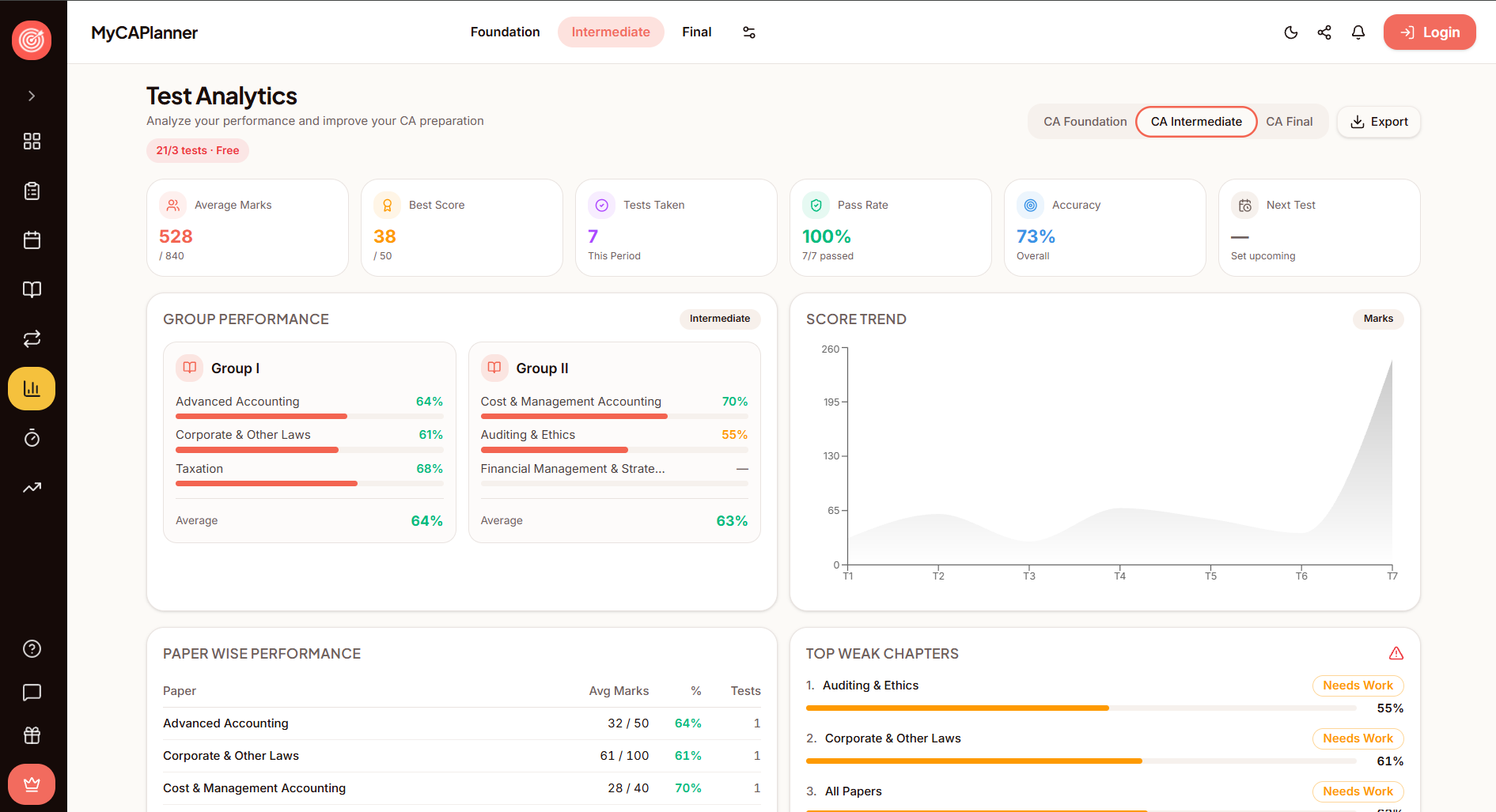
Mocks are not a scorecard; they are diagnostics. The value is in the review, which should take at least as long as the paper itself.
- Chapter tests from month one, full papers once a paper crosses roughly 70% coverage.
- Eight to twelve full three-hour papers per group in the final eight weeks.
- Write in exam conditions: no notes, no pauses, real presentation, real handwriting.
- Classify every lost mark as concept, presentation, calculation or time — the fixes differ completely.
- Convert every gap into a dated task; an unrecorded insight is a forgotten insight.
- For Paper 6, practise locating material quickly so open book saves time instead of consuming it.
Syllabus tracking that stays honest
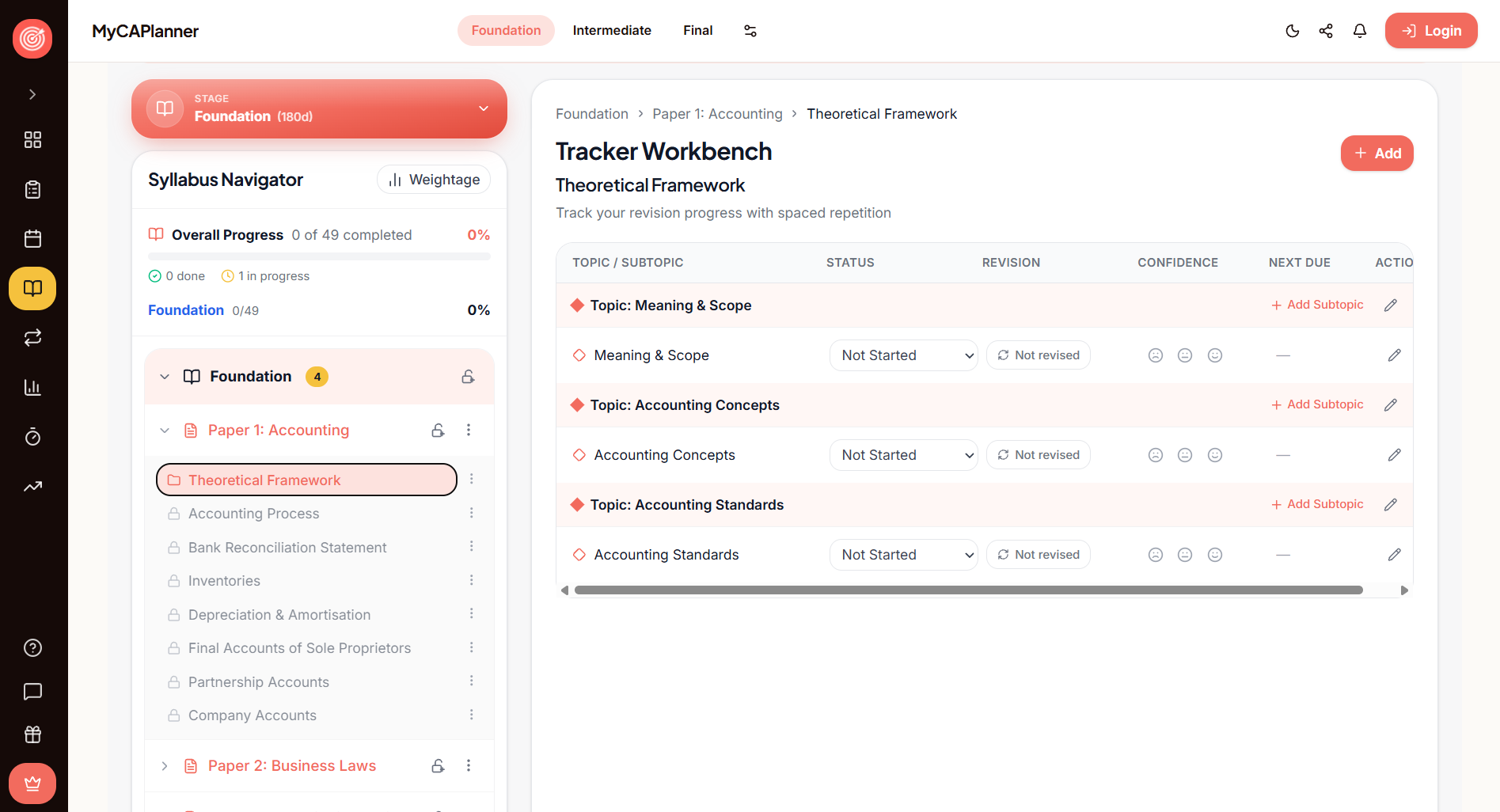
Track at topic level and mark studied, revised and tested separately. Percentage completion should come from topic counts, never from confidence.
How MyCAPlanner helps at Final level
| Problem | Feature | What changes |
|---|---|---|
| Cannot tell what is actually pending | Syllabus tracker | Topic-level coverage across all six papers |
| Revision keeps slipping | Revision cycles (R1–R5) | Chapters surface on the day they are due |
| Office days destroy the plan | Daily task board with backlog | Missed work moves instead of disappearing |
| Mock scores go nowhere | Test analytics | Trends, weak areas and dated follow-up tasks |
| Study hours feel unreal | Focus timer | Focused time recorded per subject, not guessed |
| Consistency collapses | Habits and streaks | A visible record that survives bad weeks |
Free plan available. Pro starts at ₹199 per month.
The weekly workflow in practice
- Sunday, 15 minutes: review coverage, list next week's chapters, schedule the week's test.
- Each morning: open the task board and start the first practical block before anything else.
- Each evening: mark topics done, log the focus timer, note anything that slipped.
- Each test: record the score, classify lost marks, create follow-up tasks the same day.
- Each fortnight: re-check amendment lists for the tax papers.
Notebook vs Excel vs a planner app
| Method | Strength | Where it breaks at Final level |
|---|---|---|
| Notebook | Zero friction, always available | No revision scheduling, no totals, easy to lose |
| Excel sheet | Flexible, good for coverage percentages | Manual upkeep collapses during busy season |
| Planner app | Coverage, tasks, revision and tests in one place | Requires a few honest minutes daily |
Staying consistent across a long cycle
- Keep daily targets small enough that finishing is normal.
- Review weekly, not daily — daily review turns into daily renegotiation.
- Never redesign the plan on a bad day; redesign only at the Sunday review.
- Protect one rest block a week; fatigue costs more marks than a missed chapter.
- Measure streaks, not moods. A visible record is more durable than motivation.
When you fall behind
- Count what remains instead of estimating how bad it is.
- Move only the missed items into buffer slots; do not rebuild the plan.
- Protect revision even if new learning shrinks this week.
- Drop genuinely low-weight topics deliberately rather than losing high-weight ones by accident.
- If you have lost more than two weeks, reconsider group strategy early — not in the final month.
15 common CA Final planning mistakes
- Planning in hours instead of chapters.
- Filling 100% of available time with study.
- Postponing revision until the final month.
- Treating all six papers as equally heavy.
- Reading solutions instead of solving problems in FR and AFM.
- Leaving amendments to a single last-minute pass.
- Ignoring Paper 6 until the syllabus is 'finished'.
- Writing mocks but never analysing them.
- Studying sequentially by group instead of weekly across both.
- Rebuilding the entire plan after every missed day.
- Tracking subjects rather than chapters and topics.
- Using study leave for first-time learning of major chapters.
- Confusing time at the desk with focused time.
- Skipping written recall in theory papers.
- Comparing your plan to someone with a completely different work schedule.
Planning checklist
- Attempt date fixed and weeks counted.
- Group strategy decided.
- Every chapter listed for every paper attempted.
- Final 35–45 days reserved for revision and testing.
- Weekly plan touches every paper at least twice.
- Revision dates created at the moment a chapter is finished.
- One written test scheduled every week.
- Buffer day each week, buffer week each phase.
- Sunday review in the calendar as a recurring task.
- Coverage visible as a number, not a feeling.
CA Final study planner: 20+ questions answered
What is the best CA Final study planner?
The best CA Final planner is the one that keeps working during articleship, transfer periods and study leave. It must hold three things at once: chapter-level syllabus coverage across all six papers, dated daily tasks that fit a working day, and a revision history that shows how many times each chapter has actually been revised. MyCAPlanner was built around that gap and its free plan is enough to test the habit before paying anything.
How do I make a CA Final study plan?
Work backwards from the exam date. List every chapter of the papers you are attempting, estimate sessions per chapter, split the runway into a learning phase, a consolidation phase and a revision-plus-testing phase, then convert each week into three to five dated tasks. Keep one buffer day per week for office overtime and slow chapters.
How many hours should I study for CA Final?
During articleship most students realistically manage 3 to 4 focused hours on weekdays and 8 to 10 on weekends. During study leave, 9 to 11 focused hours is the common range. Focused hours count; hours at the desk with the phone in hand do not. Track focused time and the number becomes honest very quickly.
Can I prepare for CA Final during articleship?
Yes, and most successful candidates do. The trick is protecting two fixed slots — usually early morning before office and a late evening block — rather than hunting for free time each day. Use weekdays for theory and short numerical practice, and reserve weekends for long practical papers such as Financial Reporting and Advanced Financial Management.
How should I plan CA Final Group 1?
Financial Reporting needs the freshest and longest blocks because Ind AS problems are long and unforgiving. Advanced Financial Management needs steady numerical practice rather than reading. Advanced Auditing, Assurance and Professional Ethics is memory-heavy and rewards short, frequent contact plus weekly written recall of standards.
How should I plan CA Final Group 2?
Direct Tax Laws and International Taxation and Indirect Tax Laws both need daily contact because amendments and provisions decay fast. Integrated Business Solutions is a multidisciplinary, open-book case study paper — it is prepared by practising case writing and by keeping the other five subjects usable, not by reading a new book.
Can I attempt both CA Final groups together?
Yes, but only if the weekly plan touches both groups every single week. The classic failure is spending four months on Group 1 and then discovering Group 2 has no revision time left. A both-groups plan usually starts near 60:40 and moves to 50:50 in the last two months.
How is Integrated Business Solutions (Paper 6) prepared?
Treat it as an application paper, not a new syllabus. Practise long case studies under time, build a habit of skimming a case and locating the requirement first, and rehearse using your permitted material efficiently so open book does not become slow book. Two or three full case papers a month from the consolidation phase onwards is a workable rhythm.
How do I track the CA Final syllabus?
Break each paper into chapters and then into topics, and mark each topic separately as studied, revised and tested. Percentage completion should be calculated from topic counts, never from how confident a subject feels on a given day.
How often should I revise CA Final subjects?
Three passes is the working minimum: one within a week of learning, one about three weeks later, one in the final month. Tax, Audit and Ind AS chapters usually need a fourth or fifth pass, which is why revision counts should be tracked per chapter rather than per subject.
How many mock tests should I take for CA Final?
Chapter-level tests from the first month, full-paper tests once a paper crosses roughly 70% coverage, and eight to twelve full three-hour papers per group in the final eight weeks. What you do after the paper matters more than the count.
How should I analyse CA Final mock tests?
Score first, then spend at least as long on review as you did writing the paper. Classify every lost mark as a concept gap, a presentation issue, a calculation slip or a time problem, because the fix differs for each. Then convert each gap into a dated study task instead of a vague intention.
How much study leave do I need for CA Final?
Most candidates take three to five months of leave. Leave works only if a large part of the syllabus was already covered during articleship — leave is best spent on consolidation, revision and testing, not on meeting Ind AS or Transfer Pricing for the first time.
What is the best CA Final timetable?
One that plans about 70% of your available hours. The remaining 30% absorbs office deadlines, travel, illness and chapters that take longer than expected. Rigid 100% timetables collapse in the second week and take your confidence with them.
Is self-study enough for CA Final?
For many candidates, yes, provided coverage is tracked and mock papers are written under real time pressure. Self-study fails when nobody is checking what is finished, what is stale and what has never been tested — which is exactly what a syllabus and revision tracker replaces.
What should I do if I fall behind my CA Final plan?
Do not rebuild the plan from scratch. Count the remaining chapters, move only missed items into buffer slots, drop genuinely low-weight topics if required, and protect revision even if new learning shrinks. Restarting a plan is the most common way to lose an entire week.
How do I handle amendments and updates in Tax papers?
Keep a dedicated amendment task every week rather than a single panic pass at the end. Mark amended chapters in your tracker so they automatically get an extra revision cycle, and always practise amended provisions through questions instead of only reading summaries.
How do I plan the final 45 days before CA Final?
Reserve the last 35 to 45 days almost entirely for revision and testing. Split it into a full-syllabus pass, a weak-topic pass and a final rapid pass over summaries, past ICAI questions, RTPs and your own mistake list. New chapters in this window are usually a poor trade.
Is MyCAPlanner free?
There is a free plan covering daily tasks, habits, the focus timer and basic syllabus tracking. Paid plans start at ₹199 for one month and unlock unlimited tracking, full revision cycles and test analytics. Full details are on the pricing page.
Can I use MyCAPlanner on mobile?
Yes. It runs in the browser on phone, tablet and laptop, which suits articleship where most planning happens between office tasks. Your data syncs across devices once you are signed in.
How can I stay consistent through a long CA Final cycle?
Keep daily targets small enough to actually finish, review weekly instead of daily, never edit the plan on a bad day, and protect one rest block a week. Consistency comes from repeatedly finishing small plans, not from occasional heroic days.
Does MyCAPlanner support CA Foundation and Intermediate too?
Yes. Foundation, Intermediate and Final syllabi are built in, and you can switch levels inside the app without losing earlier data.
Syllabus tracking, revision cycles, tasks, focus timer and test analytics in one place.
Related guides