
MyCAPlanner · Foundation
CA Foundation timetable
A clear plan for today.
Room for revision, practice and real life.
Turn Accounting, Business Laws, Quantitative Aptitude and Business Economics into manageable daily study slots.
Explore first. Sign in to save your progress across devices.
Cover all four papers
Give each paper a place in your week, instead of letting your favourite subject take every slot.
Keep revision in the plan
Return to earlier chapters while learning new ones. Revision deserves its own time, not leftovers.
Plan around your day
Start with the hours you actually have. A smaller timetable you follow is better than a perfect one you abandon.
Your daily starting point
Sample daily CA Foundation timetable
This example contains six hours of self-study, with breaks between blocks. Move the timings around your classes, meals and sleep. It is an illustrative schedule, not an official ICAI timetable.
Looking for the exam date sheet instead? Check ICAI’s latest examination announcements for your attempt. This page covers a personal study timetable, not exam dates.
| Study slot | Focus | What to work on |
|---|---|---|
| 7:00–8:30 am | Accounting | Work through an illustration, then solve questions without looking at the answer. |
| 9:00–10:30 am | Quantitative Aptitude | Practise a focused set of maths, reasoning or statistics questions. |
| 11:00 am–12:00 pm | Business Laws | Read one topic, recall the rule and write a short application-based answer. |
| 2:00–3:00 pm | Business Economics | Study one concept and test it with a short MCQ set. |
| 5:00–6:00 pm | Revision & error review | Recall yesterday’s topics and reattempt questions you got wrong. |
Replace broad labels with concrete tasks: “solve 15 depreciation questions” or “write two Business Laws answers.” Measure completed work, not just time spent at your desk.
A shorter timetable for college days
When your day is already busy, protect three smaller study blocks. Rotate the main paper during the week and use a less busy day for longer tests.
| Study slot | Duration | Focus |
|---|---|---|
| Before college | 60 minutes | Accounting or Quantitative Aptitude practice |
| After college | 75 minutes | Business Laws or Business Economics |
| Evening review | 45 minutes | Recall, MCQs and your error notebook |
Balance the whole week
Weekly subject rotation
Use this rotation with the shorter daily plan, or as a guide to your priority papers on longer days. Change the emphasis after reviewing your test mistakes.
| Day | Main study blocks | Review / follow-up |
|---|---|---|
| Monday | Accounting + Business Laws | Quantitative Aptitude errors |
| Tuesday | Quantitative Aptitude + Business Economics | Accounting recall |
| Wednesday | Accounting + Business Laws | Economics MCQs |
| Thursday | Quantitative Aptitude + Business Economics | Law answer writing |
| Friday | Accounting + your weakest paper | Mixed practice questions |
| Saturday | Timed chapter test + answer review | Update next week’s targets |
| Sunday | Buffer, light revision or rest | Move only unfinished tasks |
Need chapter-level coverage before assigning slots? Read the CA Foundation syllabus guide and check the applicable study material on ICAI’s official website.
A 90-day timetable roadmap
Work backwards from your target attempt. This is a flexible framework: if a phase needs more time, extend it rather than skipping topics.
01 / Days 1–45
Learn and practise
Map the remaining chapters across all four papers. Pair new learning with questions and short recall sessions. Keep a weekly buffer for unfinished work.
02 / Days 46–70
Revise and connect
Revisit covered chapters, solve mixed question sets and write theory answers. Give weak topics extra time based on actual errors.
03 / Days 71–90
Test and repair
Use timed papers and review every attempt. Reattempt mistakes, revise key concepts and keep the final days manageable rather than overloaded.
For a deeper preparation framework, explore the CA Foundation study planner guide.
Start with your actual workload
How to make a CA Foundation study time table you can follow
A useful CA Foundation timetable answers three questions: which chapter comes next, what work counts as complete, and when you will return to it. Writing “Accounts: two hours” is only a starting point. A stronger task is “work through the illustration on depreciation, solve a fresh question set, and note the adjustments I missed.” The second version gives you something you can check at the end of the session.
1. Audit your starting point
List the chapters in your applicable syllabus. Mark each as not started, learned but unpractised, practised, or due for revision. A chapter you watched in a lecture may still need independent question practice. This audit prevents a timetable from treating every topic as equally finished.
2. Protect realistic study slots
Write down classes, college, commuting, meals and other fixed commitments first. Allocate self-study in the space that remains. Keep an alternative short-day plan for busy days so a missed morning does not automatically become a lost day.
3. Estimate effort with real work
Try one representative study block before filling an entire month. Record how many questions or pages you could work through carefully, including checking answers. Use that experience to size future tasks. Harder chapters need more than a uniform one-slot allocation.
4. Assign learning, practice and recall
A chapter target should include more than first reading. Schedule a learning session, independent questions or written answers, and a later recall session. If you have already learned the chapter, replace the lecture slot with retrieval and practice rather than watching it again by default.
5. Leave space for unfinished work
Keep a buffer within the week. If everything goes to plan, use it for mixed practice or rest. If a topic takes longer than expected, the buffer lets you adjust without moving every later task. Repeated overflow is a sign to reduce the plan, not to keep adding work.
6. Review before planning the next week
Look at completed question sets, recall gaps and test errors. Decide which tasks genuinely need another session and which are done. Build the next week from this evidence, not from how many hours you hoped to study.
Keep the monthly plan broad and the daily plan specific. “Complete practice for these two chapters this week” belongs in your weekly plan; the exact question set belongs in tomorrow’s task list. This keeps the timetable flexible without making it vague.
Paper-wise CA Foundation timetable strategy
ICAI’s Foundation course includes Accounting, Business Laws, Quantitative Aptitude and Business Economics. The names are official; the study methods below are practical suggestions. Check the material applicable to your attempt before assigning chapter targets.
Paper 1: Accounting
Use a fresh study slot for understanding a method, then move quickly to independent problem solving. Watching a solution is not the same as producing the working yourself. Keep time for checking journal entries, adjustments and calculations, rather than ending the session as soon as you reach an answer.
Example task: practise a set of depreciation problems, compare the working with the answer, and classify each error as a concept gap, missed adjustment or arithmetic slip. On the next review, reattempt the questions with concept errors first. A later mixed set checks whether you can identify the right method without a chapter heading giving it away.
Paper 2: Business Laws
Divide the timetable between understanding provisions, recalling them and applying them to a situation. A first reading may feel familiar without being easy to reproduce. Close the material, explain the rule in your own words, then check what you omitted before attempting an answer.
Example task: read one topic, write a short recall outline and attempt two application-based questions. Review whether your answer identifies the relevant rule and connects it to the facts. Use the applicable ICAI material to check the legal content; do not rely on an old summary simply because it is shorter.
Paper 3: Quantitative Aptitude
Rotate Business Mathematics, Logical Reasoning and Statistics within the week instead of treating the whole paper as one undifferentiated maths slot. First practise the method accurately, then introduce timed sets. If speed is poor, check whether the problem is calculation, formula recall or choosing the method.
Example task: solve a topic-specific set, mark questions that took too long, and redo them after reviewing the relevant method. Keep a compact formula sheet, but pair each formula with a question that uses it. Reading the sheet alone does not show whether you can recognise when the formula applies.
Paper 4: Business Economics
Connect definitions to the relationships behind them. After studying a concept, explain the direction of a change or distinguish it from a similar term. Use MCQs to identify misconceptions, not just to produce a score. When you get an answer wrong, explain why your chosen option was unsuitable.
Example task: review one topic, draw or describe its key relationships, then attempt an MCQ set without notes. Record concepts you confused and revisit them in your next revision slot. Mix earlier topics into later practice so previously covered work does not disappear from the timetable.
Do not use a fixed percentage split as a permanent rule. Allocate extra sessions to a paper when unfinished chapters, repeated errors or slow question solving show that it needs them. Keep all four papers in the weekly rotation even while giving one paper temporary priority.
CA Foundation timetables for 30 days, 60 days and 6 months
Your starting point matters more than the label on the plan. A six-month timetable can accommodate initial learning; a 30-day plan is usually better used to organise revision of work you already understand. None of these windows is a promise that a particular student can complete preparation or pass within that time.
6-month study timetable: build coverage without postponing revision
Use the opening months to learn and practise chapters across all four papers. Review earlier work each week while adding new material. In the middle phase, increase mixed practice and identify chapters that were covered superficially. Reserve the later phase for broader revision, timed attempts and error repair. If college or classes take much of the day, this longer window gives you more room to spread the workload.
Set a monthly checkpoint based on evidence: chapters independently practised, theory answers attempted and topics that still require help. Do not wait until the final month to discover that “completed” only meant lectures watched.
60-day study timetable: prioritise from a coverage audit
If the basics are already familiar, separate chapters into ready for mixed practice, needing a short repair session, and needing substantial learning. Give the last group dedicated slots while keeping revision of the other groups active. A compressed timetable becomes risky when it assumes every weak chapter can be fixed in one evening.
Use your weekly test review to update priorities. Add time for checking answers and revisiting errors alongside every timed attempt. If large parts of the syllabus are untouched, reassess whether the chosen attempt is realistic rather than replacing understanding with rushed reading.
30-day revision timetable: retrieve, test and repair
Start with a paper-wise list of weak topics and recurring mistakes. In the earlier weeks, revisit these alongside mixed questions from stronger areas. In the later weeks, practise timed work, review answer quality and consolidate the notes you already use. Keep tasks specific enough to finish and check; “revise the whole subject” is too broad for a daily slot.
Avoid switching to a new collection of notes for every topic. Where a genuine gap exists, return to the applicable study material. In the final days, favour short recall, targeted corrections and a manageable routine over a timetable packed with new chapters and uninterrupted tests.
The 90-day roadmap above sits between these approaches. For more detail on organising that window, read the CA Foundation study plan guide. Adapt its targets to your own syllabus status and exam attempt.
Make revision and mock analysis part of the timetable
Revision is not one long rereading session at the end of preparation. Bring a topic back after its first study session, revisit it during the weekly review, and include it again in later mixed practice. The exact spacing can change with difficulty and recall. A chapter you repeatedly forget needs attention sooner than one you can explain and solve accurately.
Give revision a concrete output
For Accounting, independently solve a representative problem. For Business Laws, recall a provision and apply it in writing. For Quantitative Aptitude, use formulas in fresh questions. For Economics, explain a concept and test it with MCQs. These outputs help you distinguish a familiar-looking topic from one you can actually use.
Schedule the review before you take the mock
A test block needs a follow-up block. Check attempted and unattempted questions, compare your working or explanation with the answer, and classify the mistakes. Useful categories are knowledge gap, incorrect method, misread question, calculation error and time pressure. Each category calls for a different next task.
- Knowledge gap: relearn the relevant concept, then use a fresh question to check it.
- Incorrect method: compare approaches and practise identifying which one fits.
- Careless error: add a checking step and reattempt without rushing.
- Time pressure: practise a smaller timed set before repeating a full paper.
Use ICAI’s relevant question papers, revision test papers and mock test resources where available for your attempt. Confirm current instructions and timing from official sources. Do not treat the number of mocks attempted as a substitute for addressing the errors they reveal.
What to do when your CA Foundation timetable falls behind
First separate unfinished work from work that needs revision. They compete for time, but they are not the same task. An untouched chapter needs learning and practice; a chapter with a few repeated mistakes may need a short repair session. Moving both into a single “backlog” block hides the real workload.
Keep the next planned task unless the unfinished topic is a prerequisite. Move only the missed work into the buffer, then remove or defer a lower-priority task if capacity is still insufficient. If the backlog grows every week, reduce the number of new targets or split them into smaller pieces. A timetable that constantly needs rescuing is giving you useful feedback about its workload.
A weekly review checklist
- Which chapter tasks did I complete, including independent practice?
- Which errors appeared more than once, and what action will address them?
- Did each of the four papers receive meaningful study or review?
- Which tasks were oversized or placed in a slot that rarely works?
- What must move to the buffer, and what can wait without blocking progress?
- Does next week still allow breaks, meals, sleep and fixed commitments?
Common timetable mistakes to avoid
Do not count passive lecture time as complete chapter mastery, reserve your weakest paper for a slot you always miss, or schedule every available minute. Avoid collecting new resources whenever a question feels difficult. Start by identifying the exact gap in the material you already use. Finally, do not rebuild the entire plan after a bad day: adjust the unfinished tasks and resume.
For students balancing employment with preparation, the CA study plan for working professionals offers another way to think about protected study slots. Use the scheduling principles while keeping your Foundation paper targets separate.
From a timetable to daily action
Keep your plan and your progress together
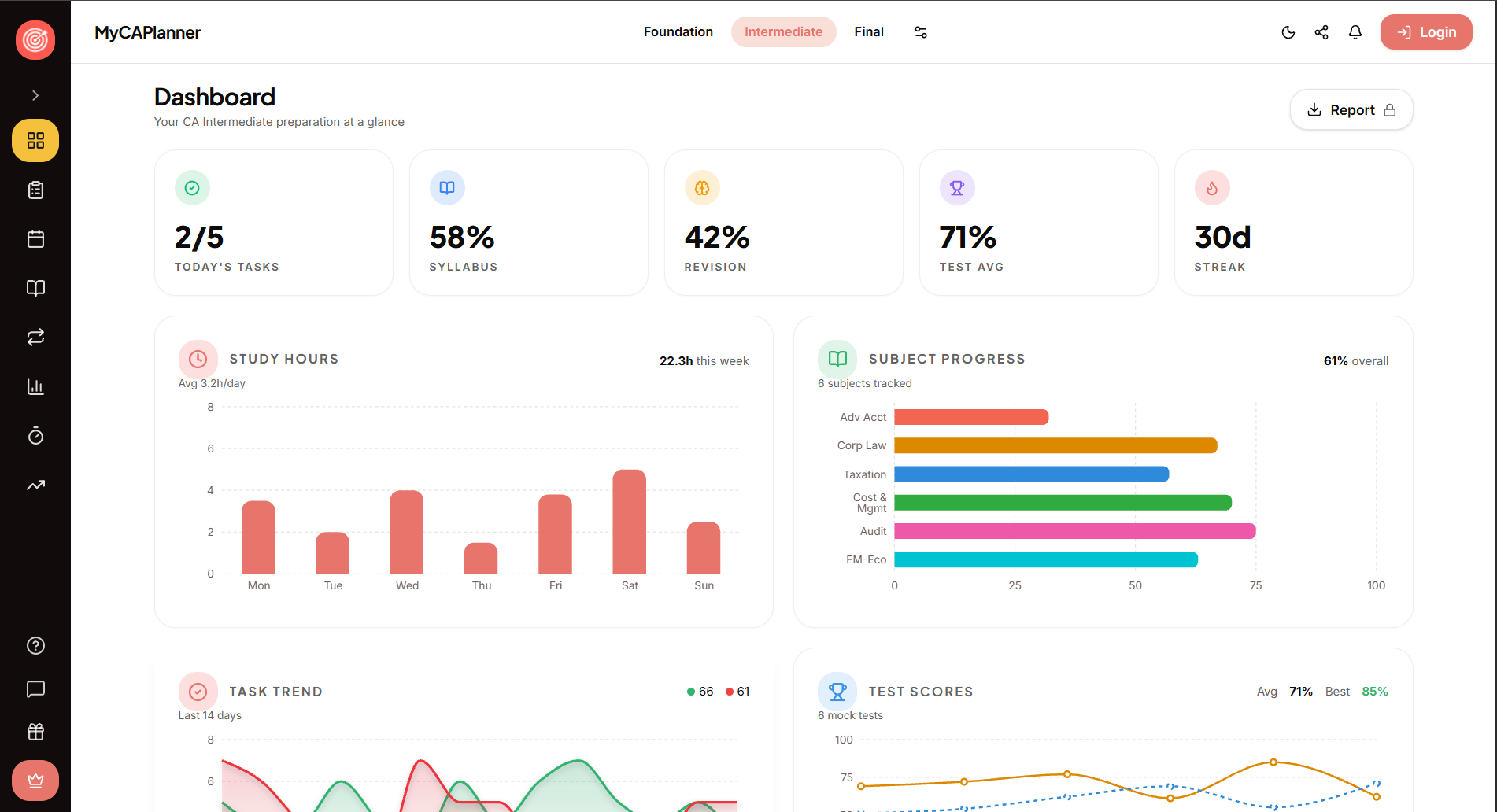
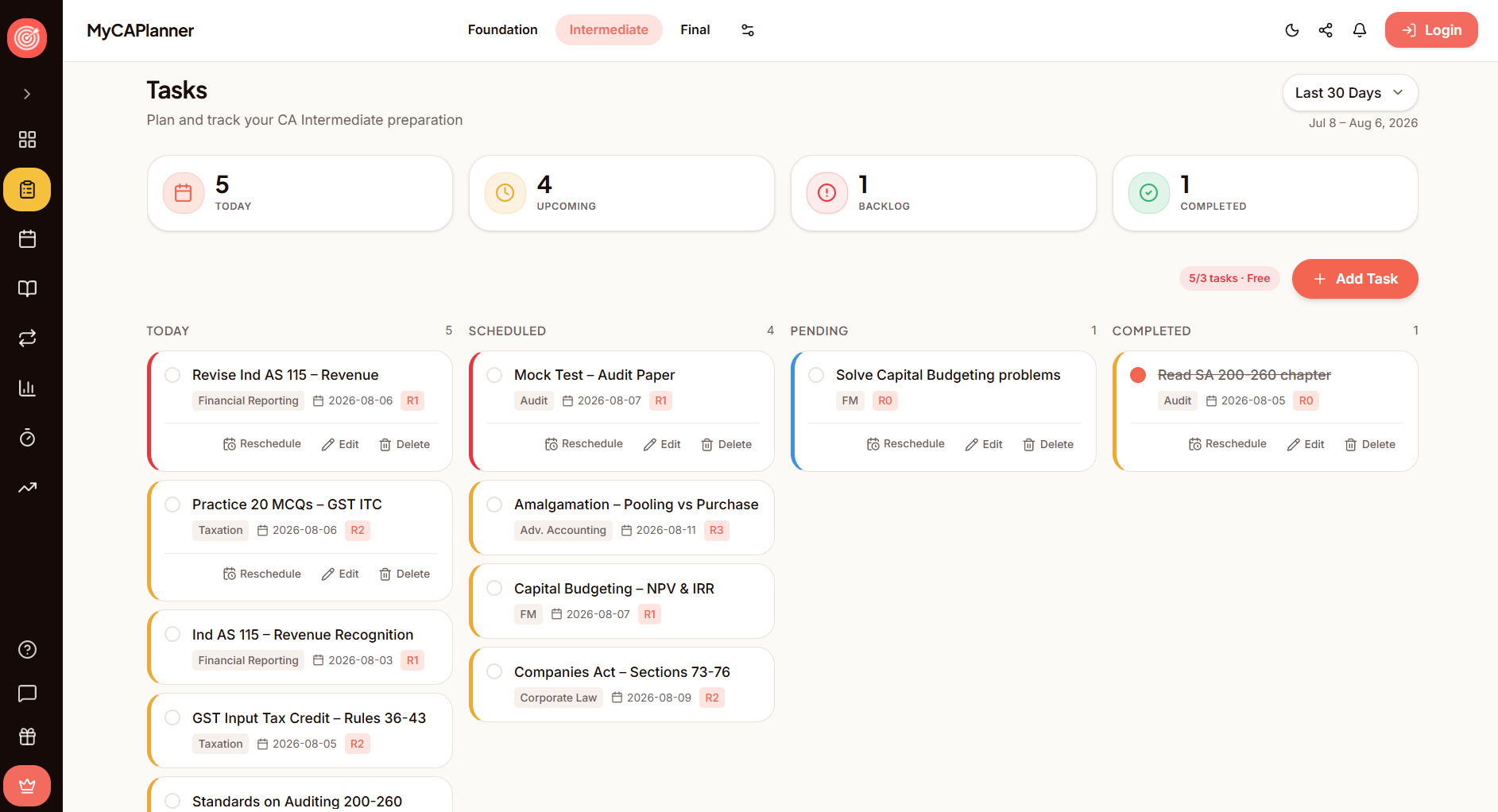
In MyCAPlanner, turn your study blocks into dated tasks, track syllabus coverage and use the focus timer during practice. Your timetable stays useful when it reflects what you actually finish.
Step 1
Choose Foundation
Set your CA level and review the chapters you still need to cover.
Step 2
Schedule specific work
Add chapter targets, practice sets and revision tasks to your available days.
Step 3
Review each week
Check completed tasks and weak topics before setting your next targets.
CA Foundation timetable FAQs
How do I make a CA Foundation timetable?
Start with the time you can reliably protect each day. Give each slot a specific chapter or question set, rotate all four papers across the week, and reserve time for revision and test review. Check the plan weekly rather than rewriting it every morning.
How many hours should a CA Foundation timetable include?
There is no single hour target that works for everyone. The six-hour example on this page is a planning template, not an ICAI requirement or a guarantee of passing. Choose a workload based on your remaining syllabus, current understanding and other commitments.
Can I follow this timetable alongside college?
Yes, with shorter slots. Use the three-hour college-day example below and place longer practice or tests on a day when you have more time. Count classes and commuting separately so your self-study plan stays realistic.
Is 90 days enough for CA Foundation preparation?
That depends on your starting point and available study time. Use the 90-day roadmap to organise work, not to assume every student can complete preparation in that period. If you are starting from scratch, assess the full syllabus before setting your deadline.
Should I study every subject every day?
You can use all four papers in a full study day, or rotate two main papers on shorter days. What matters is that every paper receives regular attention and that a difficult subject is not repeatedly pushed into next week.
What should I do when I miss a study slot?
Keep the next scheduled slot intact. Move the unfinished chapter or question set into your weekly buffer, and reduce the following week’s targets if the same backlog keeps returning. Do not sacrifice sleep to make an unrealistic timetable look complete.
Is MyCAPlanner free to start?
Yes. You can explore the planner before signing in and start with the free plan. Some features and higher limits require a paid plan. Sign in to keep your study data available across devices.
What is the difference between a study timetable and the CA Foundation exam timetable?
A study timetable allocates your own learning, practice and revision time. The exam timetable is ICAI’s official date sheet for a particular attempt. This page is a study-planning guide; check ICAI’s official announcements for examination dates and instructions.
How should I plan the last 30 days before CA Foundation?
If your syllabus is already covered, organise the final month around recall, mixed practice, timed work and correcting repeated mistakes. If substantial chapters are still untouched, audit the workload first rather than assuming a revision template will also cover first-time learning.
Can I use a six-month timetable for CA Foundation?
Yes. Use the longer window to spread first-time learning and question practice, revisit earlier chapters weekly, and leave room later for mixed practice and timed tests. Adapt the workload to your classes and existing understanding.
How do I include mock tests in my timetable?
Reserve both an attempt block and an answer-review block. Use the review to identify concept gaps, method errors and time-pressure problems, then schedule targeted follow-up work. Follow the current official paper instructions when simulating an exam.
Do I need a new timetable for each exam attempt?
Keep the useful study routine, but recheck your applicable syllabus, study material, remaining chapters and official examination dates. Update the targets and revision slots rather than copying an old attempt’s plan unchanged.
Official sources and guide scope
Updated 24 October 2026 · Prepared by MyCAPlanner. This page is an independent study-planning guide, not an ICAI announcement. The daily hours and preparation windows are illustrative; they are not official requirements or guarantees of results.
- ICAI Board of Studies: Foundation study material — check paper names and the material applicable to your attempt.
- ICAI official website — confirm examination announcements, dates and current instructions.
The screenshots show MyCAPlanner’s Intermediate demo screens to illustrate the shared app. Select Foundation in the app for your own Foundation preparation.
Make tomorrow’s study plan today.
Start with one realistic day. Build a week you can repeat.
Start free, no card needed