
On this page
What is a CA Foundation study planner?
Ask ten students and nine will say a study planner is a timetable. It isn't. A timetable answers one small question — what am I doing at 7 p.m. today? A CA Foundation study planner answers a much bigger one: am I actually going to finish this syllabus in time, with enough revision, before the exam?
Those are different problems. The first is about a day. The second is about four papers, roughly a hundred and fifty topics, and three to six months. You can follow a timetable perfectly for a month and still be badly behind, because the timetable never told you how much syllabus was left.
A planner worth the name holds four layers at once:
- Coverage — which topics of Accounts, Business Laws, Quantitative Aptitude and Business Economics you've studied at least once.
- Retention — which of those you've revised, and how many times.
- Proof — which ones you've actually tested yourself on and scored.
- Time — what you're doing today, this week, this month.
Drop any one of the four and preparation quietly breaks. Coverage without retention gives you the famous "I studied this in July, I remember nothing in December" feeling. Retention without proof gives you students who feel confident and then score 42. Time without coverage gives you students who are busy every day and still finish two chapters short.
Remember this
A CA Foundation study plan is not a document you make once in a notebook on day one. It's a living record. If it isn't changing every week, it isn't being used.
Who needs one the most
First-attempt students need it because they've never seen a syllabus this size and badly underestimate the revision load. Repeaters need it because their weak chapters are already known — the plan just has to force those chapters to the front instead of letting them hide. College-going and working students need it most of all, because they don't have spare hours to waste on figuring out what to do when they finally sit down.
Why most CA Foundation students fail to follow their study plan
Almost every student makes a plan. Very few are still following it in week six. The reasons repeat themselves so predictably that you can almost set a calendar to them.
1. The plan has no structure, only intentions
"Accounts — 3 hours" is not a plan. Three hours of what? When you sit down, you still have to decide which chapter, which sums, which book. That decision costs ten minutes and a lot of willpower, and it's the reason so many study sessions begin with twenty minutes of scrolling. Compare that with "Depreciation — SLM and WDV, 12 sums from the module." You sit and start.
2. Overplanning on day one
Fresh motivation makes people build a schedule with 11 study hours a day, no breaks and no Sundays. It works for four days. Then one bad day arrives — a headache, a family function, a low mood — and the whole thing collapses, because a plan with no slack has nowhere to absorb a miss. Students then conclude they are undisciplined. They aren't. Their plan was.
3. Burnout from studying without recovery
CA Foundation is a marathon of three to six months. Students who study 12 hours in October are usually studying 4 in November. The body settles the account eventually. Steady 6-hour days beat alternating 12s and 2s, every single time.
4. Revision gets postponed until it's impossible
This is the biggest one. Almost everyone plans revision as a block at the end — "last one month is full revision." But by then you have four papers of forgotten material and thirty days. The maths doesn't work. Revision has to be sprinkled through the whole preparation, not stacked at the end.
5. No progress tracking, so no feedback
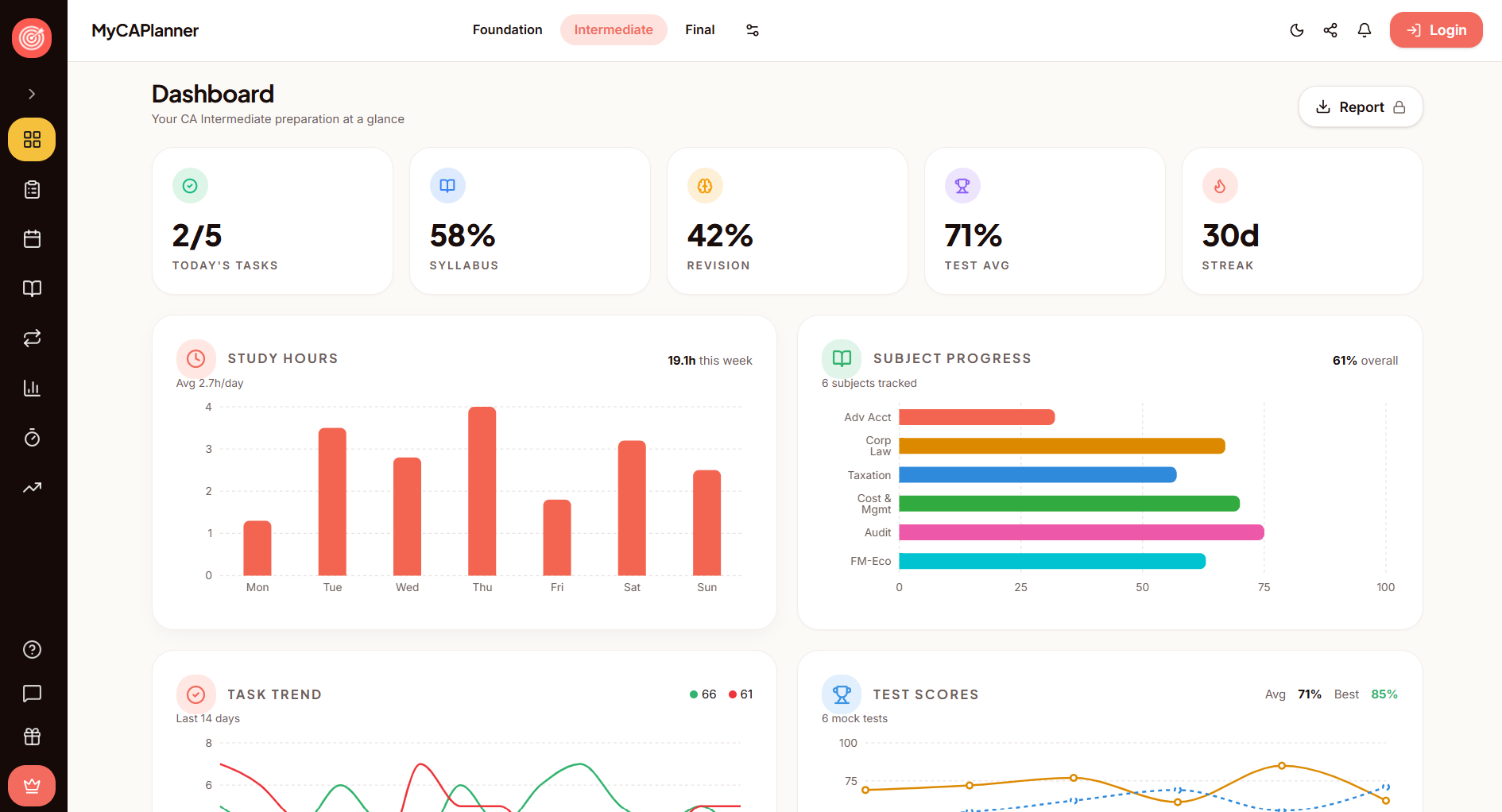
If you can't see progress, your brain assumes there is none. A student who has finished 61% of Accounts but has never counted it will feel exactly as anxious as one who has finished 20%. Anxiety then eats hours that should have gone into studying.
6. Distraction is treated as a willpower problem
It's an environment problem. The phone on the desk costs attention even when it's face down and silent, because part of your mind is monitoring it. Students who fix the environment stop needing willpower.
7. The routine has no fixed anchor
When study time floats — 9 a.m. today, 2 p.m. tomorrow, 11 p.m. the next day — every session requires a fresh decision to start. Fixed anchors remove that. The 6:30 a.m. block simply happens, the way brushing your teeth happens.
Common mistake
Redoing the entire timetable every time you fall behind. Rebuilding feels productive — it's neat, it's colourful, it takes two hours — but it produces zero syllabus. Move the missed items into your buffer day and get back to studying.
The psychology of effective study planning
Planning is far more a psychology problem than an organisation problem. Once you understand what your brain is doing, most "discipline" problems stop being mysterious.
The invisible progress problem
Studying is invisible work. A carpenter sees the table grow. A student closes the book and the room looks exactly the same as it did four hours ago. With no visible output, the mind defaults to "I haven't done enough." That feeling is not a measurement — it's just the absence of one. The fix is crude and effective: make progress physically visible. A bar that moves from 58% to 61% is a tiny thing, but it converts invisible effort into visible output, and that changes how the next day feels.
Decision fatigue
Every decision costs something. Which subject, which chapter, which book, coaching notes or study material, sums or theory — that's five decisions before you've studied a single line, at the exact moment your energy is meant to go into learning. Students who plan the night before consistently report starting faster, and they're not imagining it. They removed the decisions.
Habit loops beat motivation
Motivation is a mood; it visits and leaves. Habits are structural. A habit loop needs a cue, a routine and a reward. Cue: 6:30 a.m., desk, water bottle. Routine: 90 minutes of Accounts. Reward: ticking the box and watching the streak survive another day. After about three weeks the loop starts pulling you, rather than you pushing it.
Small wins and daily completion
Ending the day with something finished matters more than people think. Three completed items beat nine half-done ones, even if the half-done ones took longer. Unfinished tasks stay active in the mind — that's why students lie in bed mentally chewing on a chapter they left at 70%. Design your day so at least two things reach the finish line.
Study momentum and revision debt
Momentum is real and it compounds in both directions. Two good days make the third easier; two skipped days make the third much harder. Revision debt behaves like credit card debt — skip a scheduled revision and it doesn't disappear, it accrues interest in the form of a chapter you'll have to relearn from scratch instead of refresh in twenty minutes. Pay it early and it stays cheap.
Study insight
Planning is not studying. If you spend an hour designing a colour-coded timetable, you've produced an hour of zero syllabus. Give planning fifteen minutes on Sunday and five minutes each night. Spend the rest on the books.
How to create a CA Foundation study plan, step by step
Here's the actual sequence. Do these in order and you'll have a working plan in under an hour.
Step 1 — Count your real hours, not your ideal hours
Take a plain week and write down how many hours you can genuinely study each day, after college, travel, meals and sleep. Be honest to the point of pessimism. If the total is 38 hours a week, plan for about 27 — roughly 70%. The remaining 30% absorbs bad days. A plan built on your best-case day is a plan built to break.
Step 2 — Break the four papers into topics
Paper 1 Accounting, Paper 2 Business Laws, Paper 3 Quantitative Aptitude, Paper 4 Business Economics. Don't plan at paper level; plan at topic level. "Accounts" is terrifying. "Bank Reconciliation Statement — preparation of BRS" is a Tuesday evening. This single change is what makes the syllabus feel finite.
| Paper | Rough weight in your plan | Nature | Planning note |
|---|---|---|---|
| Paper 1 — Accounting | ~35% | Practice heavy | Daily contact. Never leave a two-day gap. |
| Paper 2 — Business Laws | ~20% | Theory + language | Short daily reading, heavy recall. |
| Paper 3 — Quantitative Aptitude | ~25% | Speed + accuracy | Timed practice, not slow solving. |
| Paper 4 — Business Economics | ~20% | Conceptual theory | Diagrams and definitions, weekly recall. |
Step 3 — Set monthly chapter targets
Work backwards from your exam date. If you have four months and around 30 chapters across the four papers, that's roughly 8 chapters a month, or 2 a week — with the last month reserved almost entirely for revision and mocks. Suddenly the syllabus has a size.
Step 4 — Build the weekly plan
The week is the real unit of CA preparation. Days are too small (one bad day ruins them) and months are too big (you can't feel a month slipping). Each week should carry two new chapters, revision of the previous week's material, and one test. Keep one day light.
Step 5 — Plan the day the night before
Three to five items, each specific enough to start without thinking. "QA — Ratio & Proportion, exercise 2, 15 questions, 45 minutes" is a task. "Do QA" is a wish.
Step 6 — Schedule revision the moment you finish a chapter
Don't wait. When you complete Depreciation, immediately fix its revision dates: R1 after one day, R2 after seven days, R3 after twenty-one days, and a final pass in the last month. Spaced repetition isn't a productivity trend — it's the cheapest way to keep December's memory of a July chapter.
| Pass | When | How long | What you actually do |
|---|---|---|---|
| R1 | Next day | 15–20 min | Re-read your own notes, redo 2 sums. |
| R2 | After 1 week | 25–30 min | Closed-book recall of headings, then check. |
| R3 | After 3 weeks | 30–40 min | Solve a mixed set without looking. |
| R4 | After 6 weeks | 20 min | Skim, focus only on what you got wrong in R3. |
| R5 | Final month | 15 min | One-page summary + past questions. |
Step 7 — Put mock tests in the plan from the start
Not at the end. Chapter tests from week one, subject papers once a subject crosses 70%, full mocks in the final six to eight weeks. And block the analysis time in the plan too — a mock without ninety minutes of review is just a scoreboard.
Step 8 — Keep buffer days sacred
One day a week with nothing scheduled. It's not a holiday, it's the shock absorber. Missed Wednesday's Law reading? It goes into Sunday. This one habit is the difference between a plan that lasts four weeks and one that lasts four months.
Pro tip
Write the buffer day into the plan as an actual day, not as "I'll catch up whenever." Unscheduled catch-up never happens, because there's always something new due.
How MyCAPlanner makes this easier
Everything above can be done with paper. Thousands of students have. The problem isn't making the plan — it's maintaining it for four months while the plan keeps changing. That maintenance is what eventually kills notebooks and spreadsheets.
MyCAPlanner exists to carry that maintenance for you. The full CA Foundation syllabus is already inside, broken into papers, chapters and topics, so you don't spend your first evening typing chapter names into a sheet. When you mark a topic done, the completion percentage updates on its own. When you finish a chapter, its revision dates are generated, so nothing quietly disappears. When you attempt a mock, the score joins a trend line instead of a forgotten page.
The benefit isn't "features." It's that you stop being the record-keeper of your own preparation. Every hour you don't spend maintaining a tracker is an hour of sums.
Complete feature walkthrough
Syllabus tracker
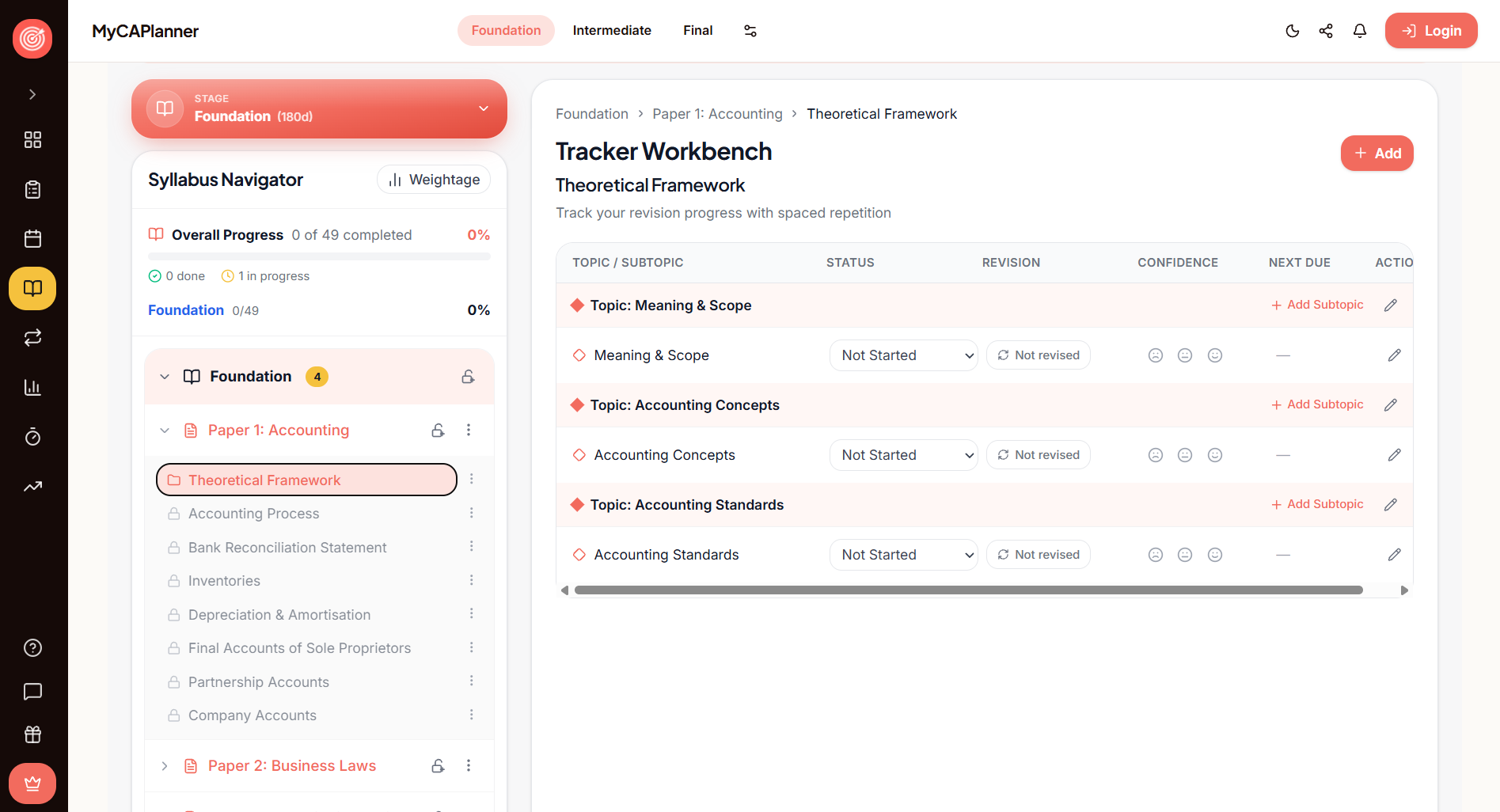
Every paper opens into chapters, and every chapter into topics. Each topic carries its own state — studied, revised, tested. Because progress is calculated from topic counts, the percentage you see is a measurement, not a mood. You can also add your own chapters and topics if your coaching follows a different sequence, and see chapter-level weightage so you know where the marks live.
Task manager
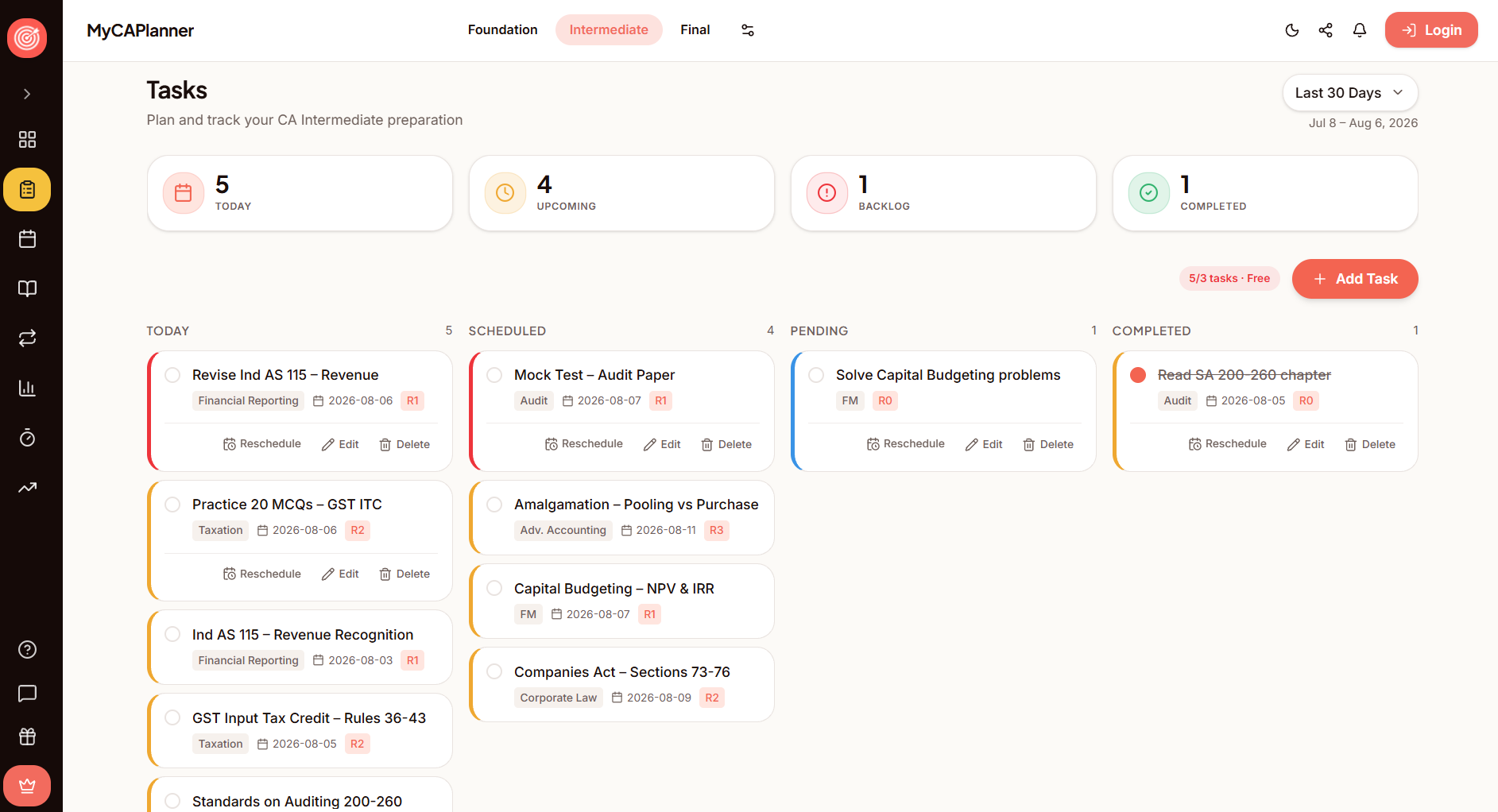
A board for Today, Upcoming, Backlog and Completed. Tasks are chapter-linked, so ticking one moves your syllabus bar too. Backlog is deliberately visible — hiding missed work is how a week's slip turns into a month's.
Study planner and calendar
The calendar shows the whole month at a glance: what's scheduled, what's overdue, where your buffer days sit. You can drag work to a different day when life happens, which is the honest way to handle a missed session — reschedule it, don't delete it.
Revision planner
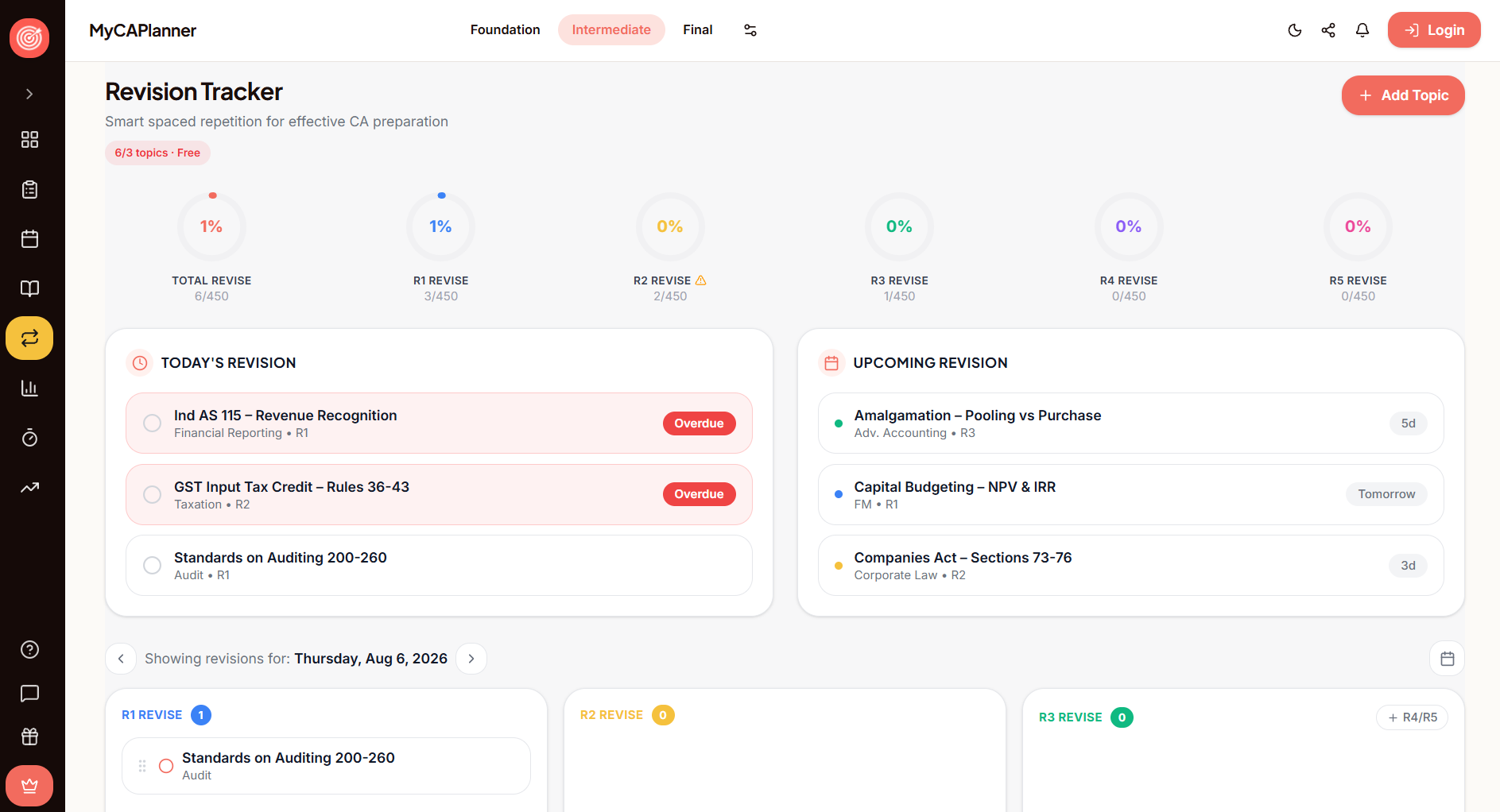
This is the part most students are missing. Finish a chapter and R1 to R5 are scheduled automatically on a spaced-repetition rhythm. Overdue revisions surface at the top so revision debt never builds silently. Today's revisions sit on the dashboard, so they're the first thing you see.
Pomodoro focus timer
Twenty-five minutes of work, five minutes off, a longer break after four rounds. Each session is tagged to a subject, so at the end of the week you can see where your hours truly went — which is usually not where you thought. The timer keeps counting on wall-clock time, so switching tabs or locking the phone doesn't cheat your record.
Habit tracker
Study hours, morning start, daily revision, no-phone blocks — whatever the handful of behaviours are that decide your result. Streaks and a seven-day view make consistency visible, and visible consistency is self-reinforcing.
Analytics dashboard and mock test analysis
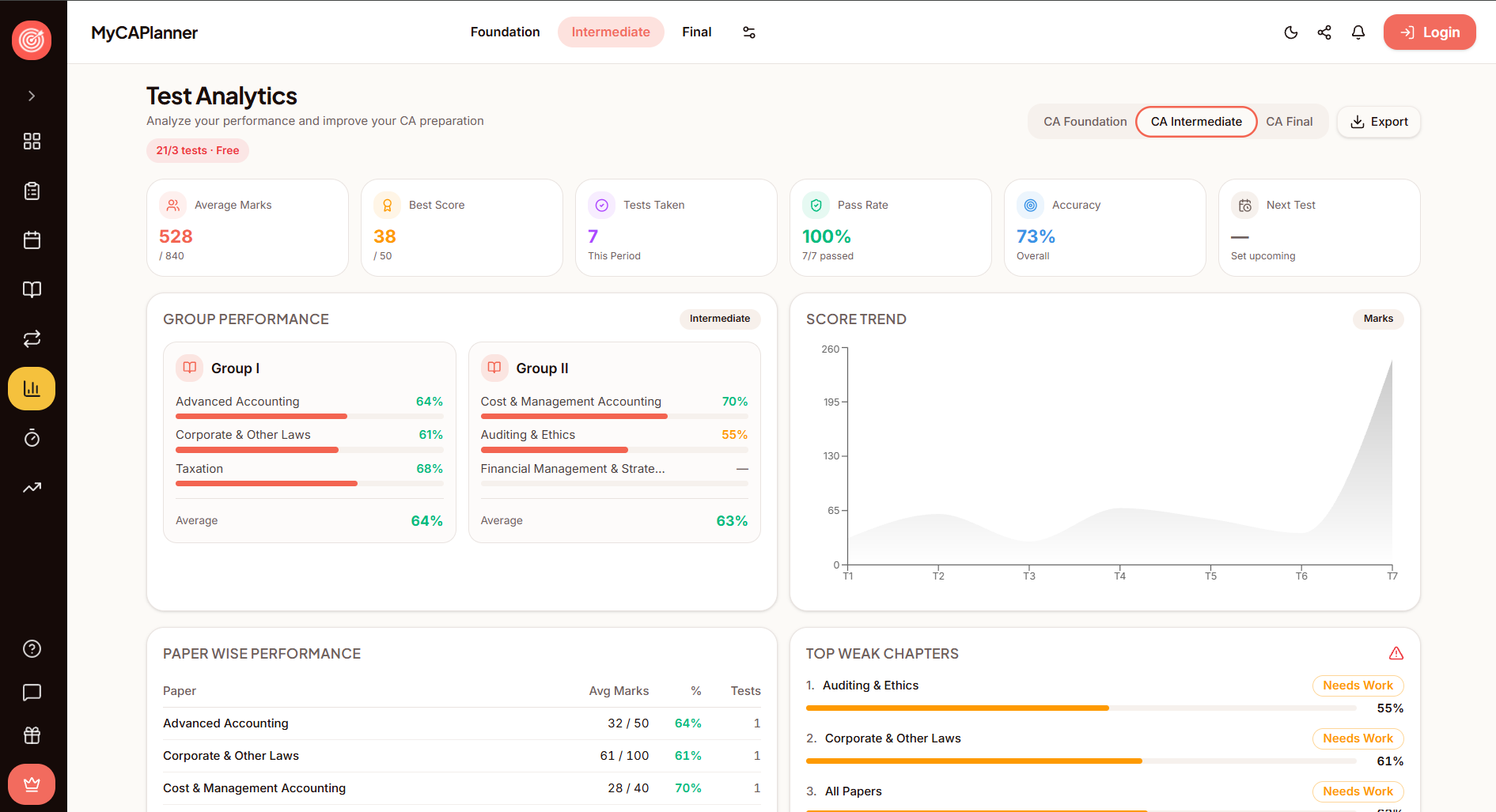
Log a test and record more than the score: chapter-wise marks, silly mistakes, concept gaps, time overruns. Over five or six tests a pattern appears — and it's almost never "I need to study more." It's usually "I lose eleven marks a paper to careless errors in Accounts" or "I never finish Section B." That's a fixable problem. A bare score isn't.
Notes, cloud sync and mobile
Chapter notes stay attached to the chapter, so your R3 revision starts from your own words. Everything syncs to your account, so the phone on the bus and the laptop at the desk show the same picture — and a lost or changed device doesn't cost you four months of records. The whole thing runs in a browser; there's nothing to install.
Try it on your own syllabus
The free plan covers daily tasks, habits, the focus timer and syllabus tracking.
Create free accountA real weekly study plan (Monday to Sunday)
Below is a realistic week for a full-time CA Foundation student in the learning phase, roughly six to seven focused hours a day. Working and college students can run the same shape at about half the volume by keeping the morning and evening blocks and dropping the afternoon one.
| Day | Morning (6:30–9:30) | Afternoon (11:30–2:00) | Evening (5:00–8:00) | Night (9:00–9:45) |
|---|---|---|---|---|
| Monday | Accounts — new chapter, concepts | QA — new topic + 20 sums | Business Laws — new section | R1 revision of Sunday's work |
| Tuesday | Accounts — sums on Monday's chapter | Economics — new chapter | QA — timed practice set | R1 revision of Monday |
| Wednesday | Accounts — continue chapter | Law — reading + case examples | QA — logical reasoning | R2 revision (last week) |
| Thursday | Accounts — chapter close + 15 sums | Economics — diagrams and recall | Law — closed-book recall | R1 revision of Wednesday |
| Friday | Accounts — mixed practice | QA — statistics block | Weak-topic slot (your choice) | R2 revision |
| Saturday | Chapter test (2 papers) | Test analysis + error log | Backlog from the week | Light reading |
| Sunday | R3 revision block | Buffer — pending items only | Plan next week (15 min) + rest | Off |
Notice three things. Accounts appears every single day, because practice subjects punish gaps. Revision has its own slot every night, not a vague promise for December. And Sunday afternoon is deliberately half-empty — that's the buffer doing its job.
Quick tip
Put your hardest subject in your best hours, not your leftover ones. Most students give Accounts the 10 p.m. slot and wonder why sums feel impossible. Swap it with the theory reading and the week changes.
A 90-day CA Foundation roadmap
Three months is tight but workable if you start on day one and don't lose weeks. Here's how the phases should feel.
| Phase | Days | Main job | Revision load | Tests |
|---|---|---|---|---|
| Phase 1 — Build | 1–30 | Cover ~50% of every paper. Accounts leads. | R1 + R2 daily, ~30 min | Chapter tests, 2 per week |
| Phase 2 — Complete | 31–60 | Finish the remaining syllabus. No new gaps left. | R2 + R3, ~45 min | Subject papers, 1 per week |
| Phase 3 — Sharpen | 61–80 | Weak chapters, past papers, speed. | R3 + R4, ~1 hour | Full mocks, 2 per week |
| Phase 4 — Peak | 81–90 | Summaries, formula sheets, calm. | R5 skim only | 1–2 mocks, then stop |
Phase 1 — Build (days 1–30)
The goal is contact with all four papers, every week. Students who spend the whole first month on Accounts alone end up meeting Economics for the first time in week nine, and it shows. Keep Accounts dominant but never let a paper go untouched for more than four days.
Phase 2 — Complete (days 31–60)
This is the grind month, and the one where most people slip. Motivation is gone, the exam still feels far, and revision debt is starting to bite. Your progress bar earns its keep here — it's the only thing that shows the work is adding up.
Phase 3 — Sharpen (days 61–80)
Full three-hour mocks, at exam time of day, on paper if you can. Score them harshly. Then spend longer analysing than you spent writing. Every mock should produce a short list of specific fixes, and those fixes become next week's tasks.
Phase 4 — Peak (days 81–90)
No new chapters. No new books. No new YouTube "must-do" lists. Only your own notes, formula sheets and past questions. Sleep properly — the last week is a memory-consolidation exercise, and memory consolidates during sleep, not during a 3 a.m. panic session.
Remember this
If you're behind at day 60, cut depth, not coverage. A shallow pass over every chapter scores far better than a deep pass over 70% and blanks on the rest.
15 common mistakes CA Foundation students make
1. Planning in hours instead of topics
"4 hours of Accounts" can mean two sums or twenty. Plan output, not duration, and time will take care of itself.
2. Leaving revision for the last month
You cannot revise four papers in thirty days if you're meeting most of the material for the second time. Revision is a daily line item.
3. Reading theory instead of recalling it
Re-reading Law feels smooth and productive precisely because it's easy. Recall is uncomfortable, which is why it works.
4. Collecting resources instead of finishing one
Three teachers' notes for the same chapter is not thoroughness, it's avoidance. Pick one source, finish it, then supplement.
5. Treating mock scores as verdicts
A 48 is data, not a judgement. The useful question is which eleven marks were careless and which were unknown.
6. Never analysing mistakes in writing
If your errors aren't logged, they repeat. A simple error log — question, mistake type, fix — is worth more than another mock.
7. Studying only the subjects you enjoy
Everybody drifts toward their strongest paper. Check your weekly hours; the gap is usually embarrassing.
8. Skipping Quantitative Aptitude practice under time pressure
QA is a speed exam disguised as a maths exam. Untimed practice builds a false sense of readiness.
9. Ignoring the ICAI study material
Coaching notes are a shortcut, not a replacement. Questions come from the module more often than students expect.
10. Pulling all-nighters before tests
Sleep is when memory gets filed. A tired 3-hour paper costs more marks than the extra chapter gained.
11. Studying with the phone on the desk
Even face down, it taxes attention. Another room, not another pocket.
12. Comparing your progress with a friend's
Different start dates, different subjects, different coaching. The only useful comparison is with your own last week.
13. Rebuilding the timetable after every bad day
Two hours of colour-coding produces zero syllabus. Move the item and continue.
14. Not tracking completion percentage
Without a number, your brain will always tell you you're behind. Often you aren't — and when you are, you want to know early.
15. Waiting for motivation to start
Motivation follows action far more often than it precedes it. Start with the smallest possible step and it usually shows up.
Notebook vs Excel vs to-do app vs MyCAPlanner
All four can work. They just fail at different points, and it's worth knowing where.
| Notebook | Excel / Sheets | Generic to-do app | MyCAPlanner | |
|---|---|---|---|---|
| Setup effort | Low | High — you build everything | Low | None — CA syllabus built in |
| Topic-level tracking | Manual, error-prone | Possible with work | Not designed for it | Built in, to topic level |
| Auto progress % | No | Only if you write formulas | No | Yes, from topic counts |
| Revision scheduling | You must remember | Manual dates | Reminders only | R1–R5 generated automatically |
| Mock test analytics | No | Charts by hand | No | Trends, chapter-wise, error patterns |
| Focus timer + hour log | Separate app | No | Sometimes | Timer tagged to subject |
| Habits and streaks | Sticker chart | No | Basic | Built in with 7-day view |
| Works across devices | One copy, losable | Yes | Yes | Yes, synced to your account |
| Customisation | Total | Total | Limited | Add your own chapters and topics |
| Best for | Week-one enthusiasm | Students who enjoy building systems | Simple daily lists | Full-length CA preparation |
The honest summary: notebooks lose to time, spreadsheets lose to maintenance, and to-do apps lose to revision. A CA-specific planner exists because this exam has a memory problem that general tools were never built to solve.
What actually changes when you go digital
- You stop guessing. "Am I on track?" becomes a number instead of a feeling, usually within ten seconds.
- Nothing gets silently dropped. Missed work moves; it doesn't vanish.
- Revision becomes automatic. The system remembers July's chapter so you don't have to.
- Your weak areas get named. Test analysis turns a vague "I'm weak in Accounts" into "I lose marks in Partnership adjustments."
- Planning gets cheap. Fifteen minutes on Sunday instead of two hours of redesign every time life interferes.
- Bad days cost less. With a buffer and a backlog view, one missed day is an inconvenience, not a collapse.
- You get evidence for confidence. Walking into the exam knowing you covered 100% and revised four times is a very different feeling from hoping you did.
How to stay consistent for the whole preparation
Fix one anchor, not the whole day
Choose one block — usually the first — and make it non-negotiable, same time daily. Everything else can float. Students who protect one anchor recover from bad weeks; students who try to protect twelve hours protect nothing.
Use the two-day rule
Never skip twice in a row. One skipped day is life. Two is the beginning of a new habit, and it's surprisingly hard to reverse. On a terrible day, do thirty minutes and mark it done — the streak matters more than the volume that day.
Make the first step embarrassingly small
"Open the module and solve one sum." That's it. Starting is the hard part; the next forty minutes take care of themselves nine times out of ten.
Review weekly, not daily
Fifteen minutes every Sunday: what got done, what slipped, what moves into next week, which topic is quietly being avoided. Daily reviews turn into daily anxiety; weekly reviews turn into course correction.
Protect sleep and one non-study evening
Six-hour nights across four months will cost you more marks than the extra hours gain. And one evening a week that belongs to you is not indiscipline — it's what makes month three survivable.
Track effort, not outcome, on hard days
Some days you'll study four hours and understand nothing. That's normal and it's not wasted. Mark the hours, log the confusion, move on. Understanding often arrives two days later, during revision.
Pro tip
Keep a one-line log at the end of each day: what went well, what didn't. Ten seconds. After a month you'll see your own patterns more clearly than any advice article can tell you.
Frequently asked questions
What is a CA Foundation study planner?
It's a system that turns the CA Foundation syllabus into dated, chapter-level work. A real planner tracks three things: what you've studied, what you've revised, and what you've tested. A timetable only tells you what to do today; a planner tells you where you stand overall.
How many hours should I study daily for CA Foundation?
Full-time students usually settle around 6 to 8 focused hours. College-going students manage 3 to 4 on weekdays and 7 to 8 on weekends. Focused hours matter more than clock hours — three hours with your phone in another room beats six hours of half-attention.
How many months are enough to prepare for CA Foundation?
Four to six months of steady study is the common range for a first attempt. Three months is possible if you study full time and skip nothing. Under two months, you're revising, not learning — plan accordingly.
Is a study planner really necessary, or is a notebook enough?
A notebook works for a week. The problem starts in month two, when you can no longer remember whether you revised Depreciation once or twice, or when you last touched Logical Reasoning. A digital planner keeps that memory for you.
What is the best free CA Foundation study planner?
The best one is the one you actually open daily. MyCAPlanner has a free plan that covers the daily basics — tasks, habits, a focus timer and syllabus tracking — so you can test the habit before spending anything.
How do I make a CA Foundation timetable that I'll actually follow?
Plan 70% of your available hours, not 100%. Leave one buffer day per week. Fix the first study block of your day at the same time every day, so starting stops being a decision.
Which subject should I start with in CA Foundation?
Start with Accounts. It's the heaviest, the most practice-driven, and the one that punishes late starts. Pair it daily with a lighter theory subject so your brain gets variety.
How should I divide time between the four papers?
A common working split is Accounts 35%, Business Laws 20%, Quantitative Aptitude 25% and Business Economics 20%. Adjust after your first mock, not before.
How many revisions are needed before the exam?
Three is the practical minimum: one soon after learning, one about two weeks later, one in the final month. Weak chapters usually need a fourth or fifth pass.
When should I start solving mock tests?
Chapter-level tests from week one. Full-subject papers once a subject is 70% covered. Full three-hour mocks in the last six to eight weeks, at the same time of day as the real exam.
How many mock tests should I attempt?
Somewhere between eight and fifteen full mocks, but the number is less important than the analysis. One mock you spend ninety minutes reviewing teaches more than four you only score.
What should I do if I fall behind my study plan?
Don't rebuild the whole plan. Move only the missed items forward into your buffer day and continue. Restarting from scratch is the single most common way students lose a week.
Can working professionals or college students clear CA Foundation?
Yes, and they usually do it by protecting two fixed slots — early morning and late evening — instead of hunting for free time. Consistency beats volume for this group.
Is self-study enough for CA Foundation?
For most students, yes, provided the study is tracked. Self-study fails when nobody is checking coverage. That's exactly the gap a syllabus tracker fills.
How do I track CA Foundation syllabus completion?
Break each paper into chapters, then chapters into topics, and mark each topic as studied, revised or tested. Percentage completion should come from topic counts, not from a feeling.
What's the difference between a study planner and a to-do app?
A to-do app forgets a task once it's ticked. A study planner remembers it and brings it back for revision. CA preparation is a memory problem, not a task problem.
Should I make a monthly or a weekly plan?
Both, at different levels of detail. Monthly plans hold chapter targets. Weekly plans hold day-wise blocks. Daily plans hold only three to five items.
How do I revise theory subjects like Law and Economics?
Active recall. Close the book and write the section headings from memory, then check. Reading Law again feels productive but rarely survives exam pressure.
How do I stop procrastinating during CA Foundation preparation?
Shrink the first step. "Study Accounts" invites delay; "solve two sums from Depreciation" doesn't. A 25-minute timer helps because it puts a visible end to the discomfort.
Does MyCAPlanner work on mobile?
Yes. It runs in the browser on phone, tablet and laptop, and your data syncs across all of them once you sign in.
Do I lose my data if I switch devices?
No. Data is stored in your account, not on the device, so signing in on a new phone restores your syllabus progress, tasks and test history.
Is MyCAPlanner only for CA Foundation students?
No. It supports Foundation, Intermediate and Final, with the syllabus for each level built in. You switch levels from inside the app.
Final thoughts
CA Foundation isn't won by the student with the most hours. It's won by the one whose hours stayed consistent, whose revision stayed current, and who knew — in numbers, not feelings — where they stood each week. That's an unglamorous advantage, and it's completely available to you.
Start smaller than you think you should. One anchored study block, topic-level targets, revision scheduled the day you finish a chapter, one buffer day, one weekly review. Do that for three weeks and the plan stops needing willpower. Add mock analysis in month two and you'll be ahead of most of the hall.
If you'd rather not maintain all of that by hand, that's exactly the job MyCAPlanner does. The CA Foundation syllabus is already loaded, revision cycles build themselves, and the dashboard answers the only question that matters on a rough Tuesday: am I actually getting there? You can find the daily tools on the free plan, read more strategy on the blog, or write to us on the contact page if something's unclear.
Start your CA Foundation plan today
Load the syllabus, set your exam date, and let the tracker handle the rest. It takes about five minutes to set up.