
MyCAPlanner · Foundation, Intermediate & Final
CA mock test analysis
Every mock tells you what to study next.
Learn to read it properly.
A mock test only improves your score when the review is honest and specific. Here is a practical way to analyse every attempt — and turn weak areas into next week's plan.
Explore first. Sign in to save your progress across devices.
The score is the start
A mock score tells you where you stand. The mistake pattern underneath it tells you what to do about it.
Fix categories, not questions
One wrong question is an accident. Five wrong questions of the same type is a fixable weakness.
Reattempt to confirm
Solving the wrong questions again a few days later is the only proof the concept is actually repaired.
The five-step review
How to analyse a CA mock test
Run this process after every full mock or timed chapter test, at any CA stage. Budget roughly the same time as the mock itself — the review is where the improvement happens.
Step 1
Score it honestly
Mark the paper strictly against the suggested answers. An inflated score hides the exact problems you need to fix.
Step 2
Classify every lost mark
Tag each mistake as a concept gap, method error, silly mistake, time-pressure issue or presentation problem. The category decides the fix.
Step 3
Log it paper-wise
Record your score, accuracy and top mistake categories for each paper so you can compare mock to mock.
Step 4
Schedule the repairs
Convert the biggest weaknesses into concrete tasks for the coming week — a chapter to relearn, a question set to redo, a timed section to practise.
Step 5
Reattempt the wrong questions
A few days later, solve the questions you got wrong without looking at the answer. If they still fail, the concept is not fixed yet.
Know your mistake types
Classify every lost mark
Each category of mistake has a different fix. Treating a concept gap like a silly mistake — or the other way round — is why scores stay flat.
| Mistake type | What it looks like | The fix |
|---|---|---|
| Concept gap | You did not know the rule, formula or provision | Relearn the topic from your study material, then solve a small set of similar questions before moving on. |
| Method error | You knew the concept but applied it incorrectly | Redo the full question with correct working. Note the exact step where your approach went wrong. |
| Silly mistake | Calculation slips, misread questions, sign errors | Slow down on that question type. Add a 2-minute re-check habit at the end of every practical paper. |
| Time pressure | You ran out of time or rushed the last questions | Practise timed sections. Decide in advance how many minutes each question gets and move on when the limit hits. |
| Presentation / writing | Marks lost on format, working notes or answer structure | Study the suggested answer's presentation. Rewrite one of your weak answers in the proper format. |
After each mock, count how many marks you lost per category. Whichever category costs you the most marks becomes the priority in next week's study plan.
Track the trend, not the single score
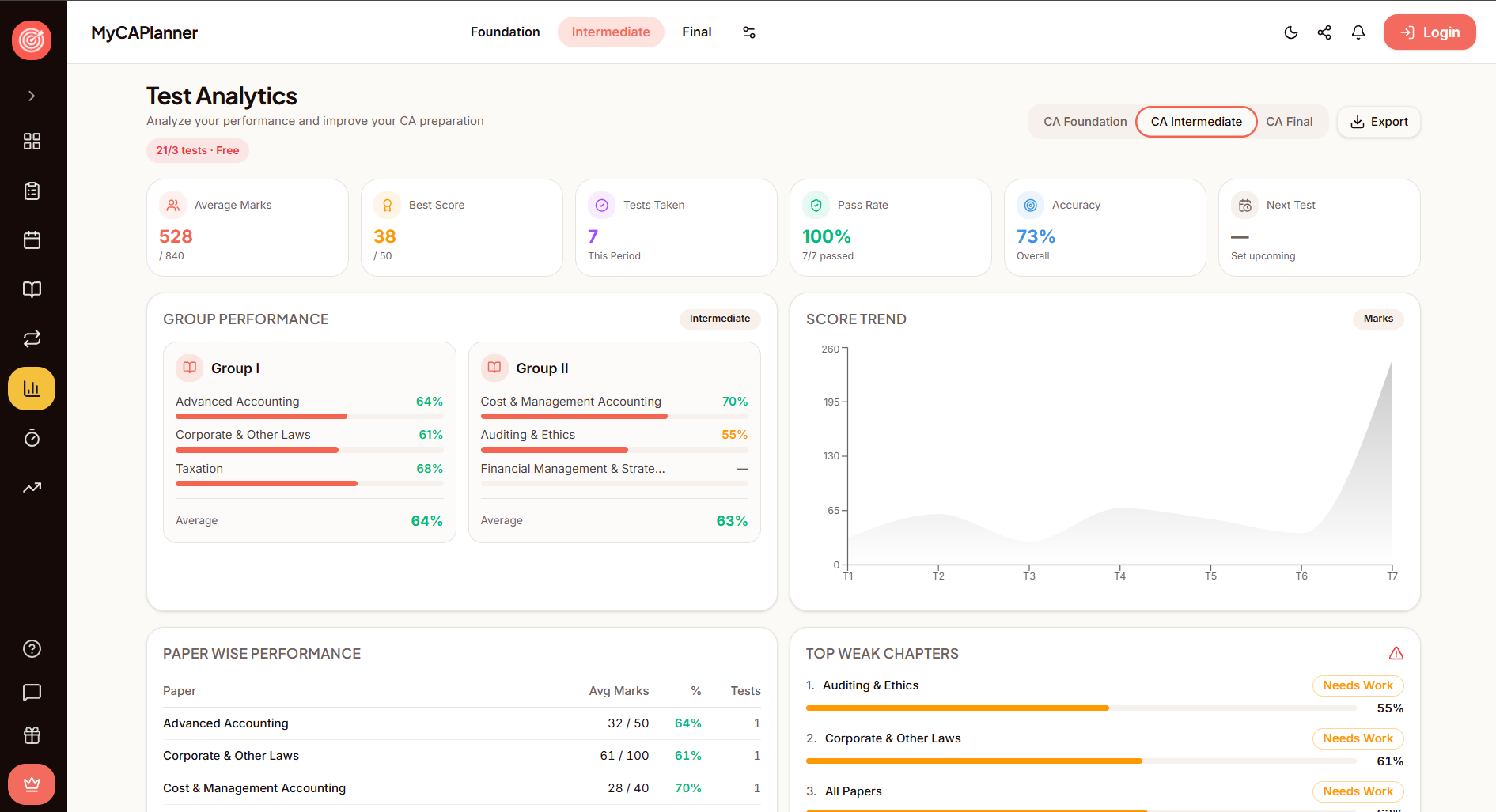
One mock is a snapshot. Three or four mocks, logged the same way, show a trend. Keep a paper-wise record of every attempt: the date, your score, your accuracy and the dominant mistake category. When the same category keeps costing you marks, that is your loudest study signal.
Planning when to fit mocks in? See the CA timetable 2027 guide for daily and weekly schedules with built-in test and review slots, or the CA Foundation timetable for a stage-specific plan.
Stage-wise notes
Mock analysis at each CA stage
CA Foundation
Watch silly mistakes and time pressure most — the MCQ format punishes both. Track negative-marking losses separately so you know whether guessing is helping or hurting.
Foundation plannerCA Intermediate
With six papers across two groups, log scores per paper so one strong subject does not hide a weak one. Method errors in practical papers and presentation in theory papers are the usual score leaks.
Intermediate plannerCA Final
Mocks must fit around articleship, so protect the review slot as firmly as the attempt slot. Case-study and application-based questions need special attention to how suggested answers structure the working.
Final plannerCA mock test analysis FAQs
How do I analyse a CA mock test?
Score the paper strictly, then classify every lost mark into a category: concept gap, method error, silly mistake, time pressure or presentation. Log the result paper-wise, schedule targeted repair work for the coming week, and reattempt the wrong questions a few days later. The analysis matters more than the score itself.
How many mock tests should I attempt before my CA exam?
There is no fixed number that suits everyone. What matters is that every mock you attempt gets a full, honest review. Two or three well-analysed mocks per paper usually teach you more than ten mocks you never review. Plan both an attempt block and a review block in your timetable.
What is a good mock test score for CA Foundation, Inter or Final?
Treat mock scores as a trend, not a verdict. If your paper-wise scores and accuracy are rising across mocks and the same mistakes are not repeating, your preparation is moving in the right direction. A single low score is a signal about specific topics, not a prediction of your exam result.
Should I attempt mocks before finishing the syllabus?
Chapter-wise tests are useful from early in your preparation. Full-length mocks work best once most of the syllabus is covered, because they test time management and question selection across the whole paper. Before that, use timed chapter or module tests instead.
How do I track mock test scores for CA?
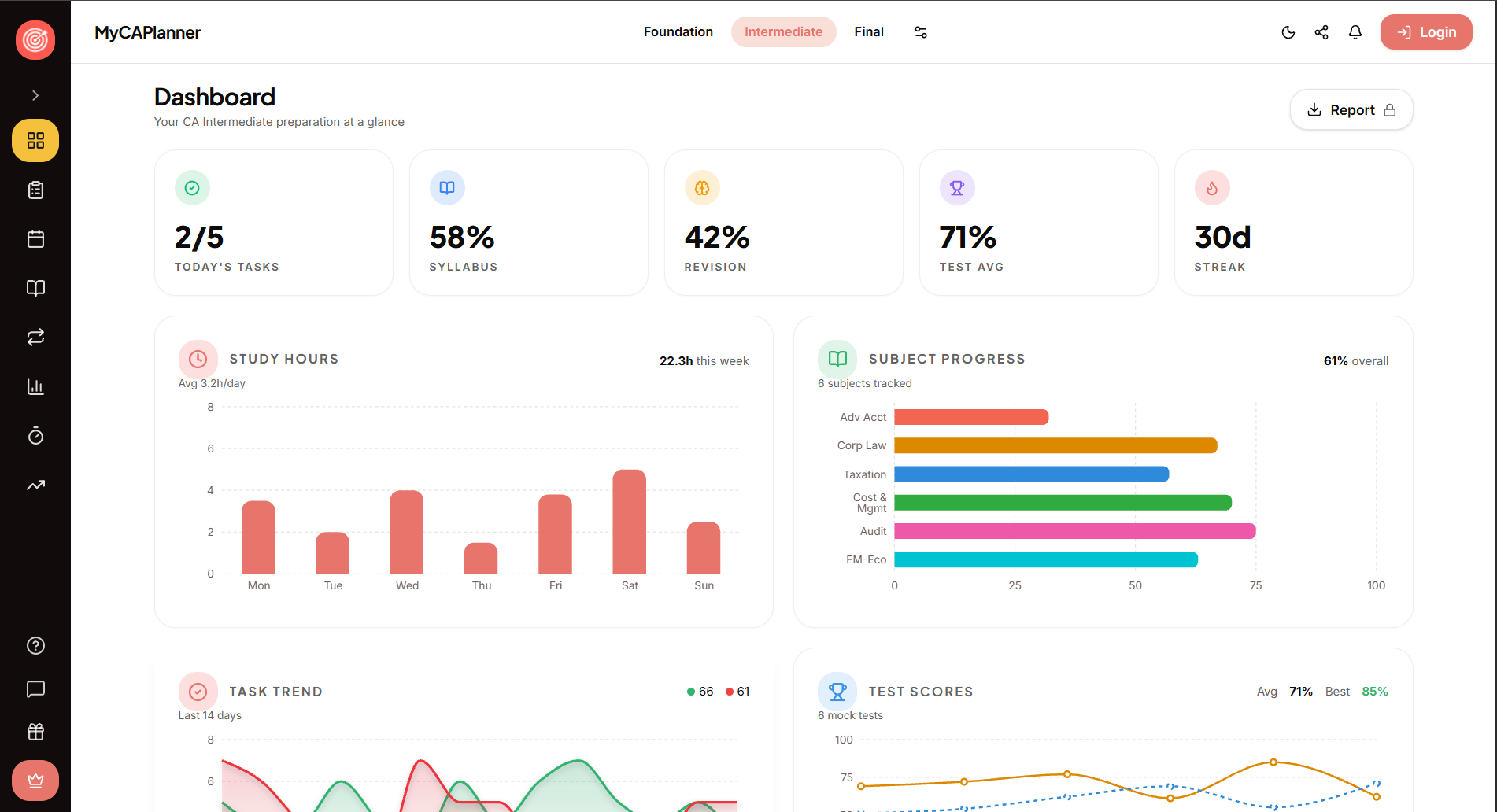
Keep a simple paper-wise log: date, score, accuracy, and the main mistake categories. In MyCAPlanner you can record each mock's marks and accuracy in the test analysis section, so your trend across attempts is visible on the dashboard without maintaining a separate spreadsheet.
What should I do if my mock scores are not improving?
Check whether the same mistake category keeps repeating. If concept gaps dominate, pause new mocks and relearn those topics. If time pressure dominates, practise timed sections. If silly mistakes dominate, add a re-check habit. Repeating mocks without changing the underlying habit rarely moves the score.
How long should mock test analysis take?
Plan roughly the same time as the mock itself, split across one or two sittings. A three-hour paper deserves at least two to three hours of review: marking, classifying mistakes, and noting the follow-up work. Skipping the review is the most common reason mock practice does not improve scores.
Where can I get CA mock test papers?
ICAI publishes mock test papers for each attempt on its official website, and the suggested answers are released alongside them. Use the official papers for your stage and attempt, and follow the current paper instructions when you simulate the exam.
Official sources
- ICAI — official website · mock test papers, suggested answers and examination announcements
This is a study-method guide, not an official ICAI publication. Always confirm paper patterns and instructions for your attempt on ICAI's website.
Your next mock deserves a proper review.
Log your scores, spot the pattern and plan the fix — all in one place.
Start free, no card needed