
MyCAPlanner · Foundation, Intermediate & Final
CA revision planner
Finish the syllabus and the exam is still lost.
Revision is where marks are won.
A practical revision planner for CA aspirants — how many passes to plan, a spaced-repetition schedule you can copy, a last-30-day plan and stage-wise notes.
- Four revision passes, each with a different job
- A spaced-repetition schedule you can copy today
- A last-30-day plan from mocks to exam day
Explore first. Sign in to save your progress across devices.
Revision beats re-reading
Re-reading a chapter feels productive and returns almost nothing. Actively recalling formulas, entries and provisions from a blank page is what makes them available in the exam hall.
Spacing beats cramming
The same four hours of revision, spread across a week with gaps, holds far better than one marathon session. Gaps are where the forgetting — and the re-learning — happens.
Revision needs its own time
Revision that only happens in the leftover time at the end never gets done. Put it in the calendar as a fixed block, with the same status as a new chapter.
The four passes
What each CA revision pass is for
Most students revise the same way every time — open the book and read again. That is why the third pass feels no better than the first. Each pass below has a different job, and you only move on when its check is met.
| Pass | When | What you actually do | Done when |
|---|---|---|---|
| Pass 1 · Coverage | Right after finishing a subject | Read through once and make the notes you will revise from: formula sheets, journal-entry patterns, section lists, adjustments, case-law one-liners. Aim for one page per chapter. | You can list every chapter's headings from memory. |
| Pass 2 · Recall | 1–2 weeks after Pass 1 | Notes closed. Write what you remember of a chapter, then open the notes and mark what you missed. Only the missed parts get re-read. | You can reproduce the key working or entries unaided. |
| Pass 3 · Application | Before the mock phase | Solve questions and past papers from that chapter without prep. Every wrong answer sends you back to that specific page of notes. | You can answer exam-style questions inside the time limit. |
| Pass 4 · Compression | Final 2–3 weeks | Revise only your marked gaps and one-page sheets. No new material, no full-text reading. Short, frequent, high-frequency sessions. | You can revise a full paper in one sitting from your own sheets. |
If time runs short, cut Pass 1 down and protect Pass 2 and Pass 3. Recall and application are what convert preparation into marks; coverage on its own is not revision.
A schedule you can copy
Spaced repetition for a CA chapter
This is the revisit pattern behind every good revision planner. Six short touches across a month beat one three-hour session the night before the exam, because each touch forces recall rather than recognition. Apply it per chapter as you finish it, not to the whole syllabus at once.
| After studying | Time | What to do |
|---|---|---|
| Day 0 | Study the chapter | Learn it once and write your one-page revision sheet the same day. |
| Day 1 | 10 minutes | Recall the sheet from memory before you start anything new. |
| Day 3 | 10 minutes | Re-write the key formulas, entries or provisions. Mark what slipped. |
| Day 7 | 15 minutes | Solve 5–8 questions from the chapter, timed. |
| Day 15 | 15 minutes | Recall again, then re-read only the parts you missed on Day 3 and Day 7. |
| Day 30 | 20 minutes | Full chapter recall plus a short mixed set with the previous chapter. |
Total time per chapter: about 70 minutes spread over a month. With 20 chapters in a subject, that is roughly 45 minutes of revision a day — which is why revision has to be planned from the start, not squeezed in at the end. Scheduling these touches is easier with a CA timetable that already blocks study, revision and test slots.
The last 30 days
A CA revision plan for the final month
The last month is not for finishing the syllabus. It is for converting what you already know into marks. This plan works for Foundation, Inter and Final — scale the number of papers to your group.
| Days before exam | Focus | What the day looks like | Done when |
|---|---|---|---|
| Days 30–21 | Pass 3 · Application | Subject-wise question practice and past papers. Two subjects per day, one theory and one practical. Log every wrong question. | Weak chapters are listed and scheduled. |
| Days 20–11 | Mock phase | Full mock per paper on rotation, followed by a proper review the same day or next. Convert review findings into tasks. | Scores and accuracy logged paper-wise. |
| Days 10–4 | Pass 4 · Compression | Only one-page sheets and marked gaps. Short sessions, all subjects touched every two days. No new material at all. | Every paper revisable in one sitting. |
| Days 3–1 | Exam mode | Revise the nearest paper's sheets, sit the exam-time slot for that paper, and keep the schedule light. Sleep matters more than one extra chapter. | You are revising, not learning. |
Mocks only pay off if they are reviewed. Use the CA mock test analysis method to classify every lost mark, then feed the biggest mistake category straight into the next revision slot.
Stage-wise notes
Revision at each CA stage
CA Foundation
Revision is mostly speed and accuracy. Drill the four sections — Accounts, Maths, Economics, Law — with timed MCQ sets, and keep a running list of the traps you fall into. Law needs verbatim recall of section numbers and case names, so it deserves short daily touches.
Foundation plannerCA Intermediate
Six papers across two groups means six revision tracks. Log revision per paper, not per group, so a strong subject never hides a neglected one. Alternate a practical and a theory paper each day, and keep one weekly slot per paper for question practice.
Intermediate plannerCA Final
Articleship leaves little room, so revision has to be portable: one-page sheets, recall on commutes, and one protected long block each weekend. High-weightage chapters come first, and every mock review becomes a scheduled repair task.
Final plannerTrack revision the way you track the syllabus
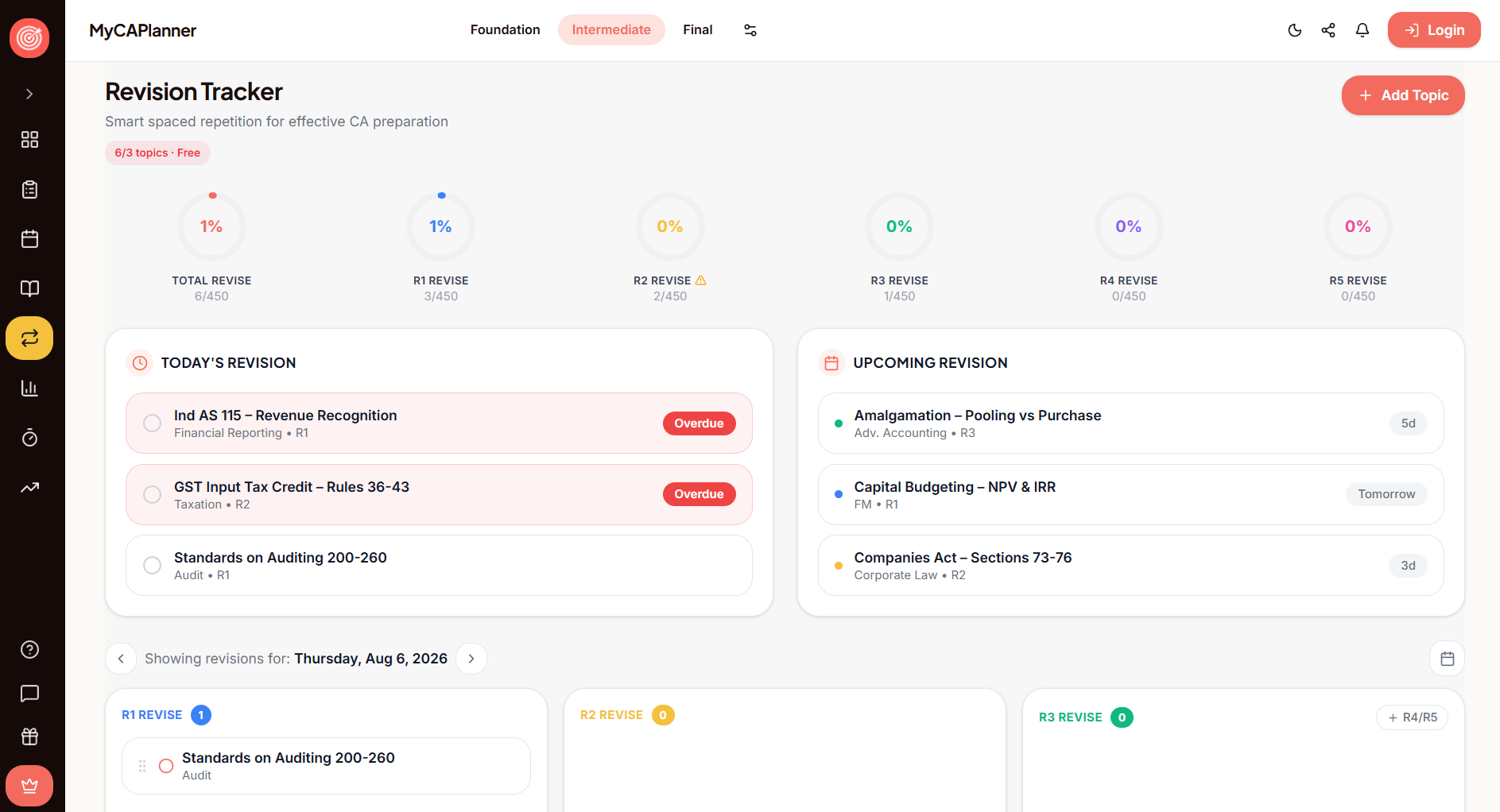
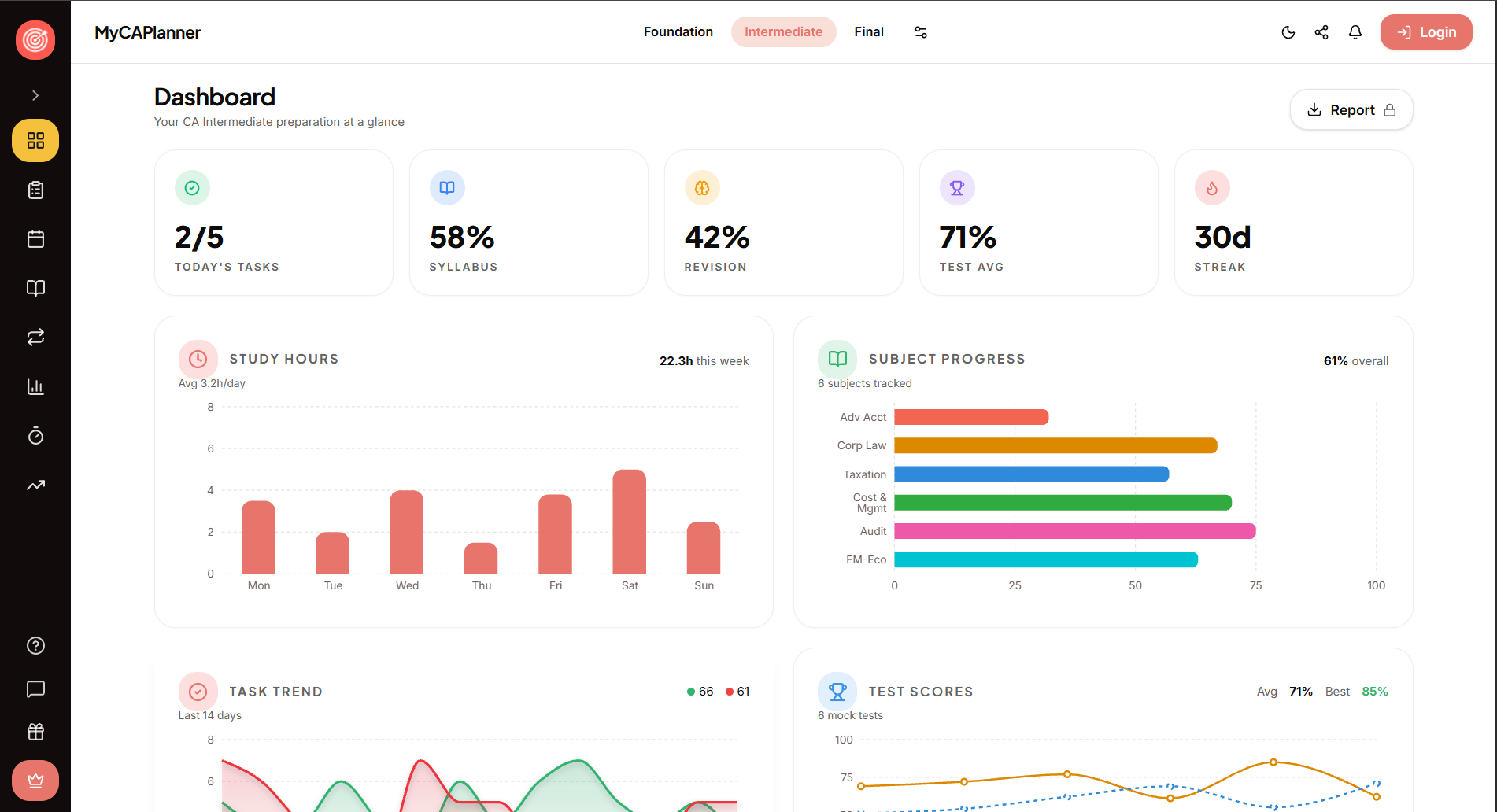
"I revised Accounts" is not a useful statement two weeks before an exam. Which chapters, which pass, and what did you miss? MyCAPlanner keeps revision as a checklist of its own — chapter by chapter, pass by pass — alongside your syllabus progress, tasks and test records, so the gaps are visible instead of remembered.
Still deciding how to structure the day? Read CA study planner app vs Notion, or start with the free ICAI study planner setup.
CA revision planner FAQs
How much revision is enough for CA?
Plan at least three full passes over every subject before the exam, with a fourth compressed pass in the last two to three weeks. The count matters less than the method: a pass where you recall from a blank page and mark your gaps is worth several passes of silent re-reading. If you cannot reproduce a chapter's key working without your notes open, that chapter has not been revised yet.
How many days should I keep for CA revision?
Keep roughly the last 30 days of your preparation for revision and mocks, and put revision inside your study blocks from day one rather than at the end. A student starting six months out should finish new material by day 150 and live in revision mode after that. With less time, shrink the coverage pass and protect the recall and application passes instead.
What is spaced repetition for CA students?
Spaced repetition means revisiting a chapter at widening gaps — one day, three days, a week, two weeks, a month — instead of once. Each revisit forces recall, which is what makes the material retrievable under exam pressure. A CA revision planner that schedules those revisit dates for you is far more useful than a list of chapters you intend to 'revise later'.
How do I make revision notes for CA?
Make them the day you finish the chapter, not later. One page per chapter: formulas and rates, standard journal-entry patterns, adjustment steps, section and definition lists, and a short 'I always forget this' line. Notes you make weeks later copy the textbook instead of capturing your gaps, and gaps are the only thing worth revising from.
Should I revise theory or practical subjects first?
Alternate them. A practical paper after a theory block keeps the day useful, since one needs writing recall and the other needs working speed. Do not leave practical subjects to the end of the day when fatigue makes calculation errors likely, and do not leave theory for the last week — theory needs more passes, not more hours in one sitting.
How do I revise a full CA paper in one day?
Use your own compressed sheets, not the study material. Work through the chapter list from memory, marking anything you cannot reproduce, then re-read only those. Add one short mixed question set to check application. This only works if you built the sheets during your earlier passes — a one-day revision of a paper you have never compressed is not realistic.
What is the best revision plan for CA Intermediate?
Treat all six papers as six separate revision tracks. Log revision completion per paper, not per group, so a strong subject never hides a neglected one. Alternate a practical and a theory paper each day, keep one weekly slot per paper for question practice, and start every study session with ten minutes of recall from the previous week's weakest paper.
How should working professionals plan CA revision?
Anchor revision to fixed slots you can actually protect — early mornings, commutes, and one longer weekend block — and keep the material in a form those slots can handle: one-page sheets, flashcard-style recall, and short question sets. Because total hours are limited, prioritise recall of high-weightage chapters over fresh coverage, and revise on the days you cannot study anything new.
Official sources
- ICAI — official website · syllabus, study material, past papers and examination announcements
This is a study-method guide, not an official ICAI publication. Always confirm the syllabus and exam pattern for your attempt on ICAI's website.
Plan the revision, don't hope for it.
Track every pass, chapter by chapter, and see the gaps before the exam does.
Start free, no card needed